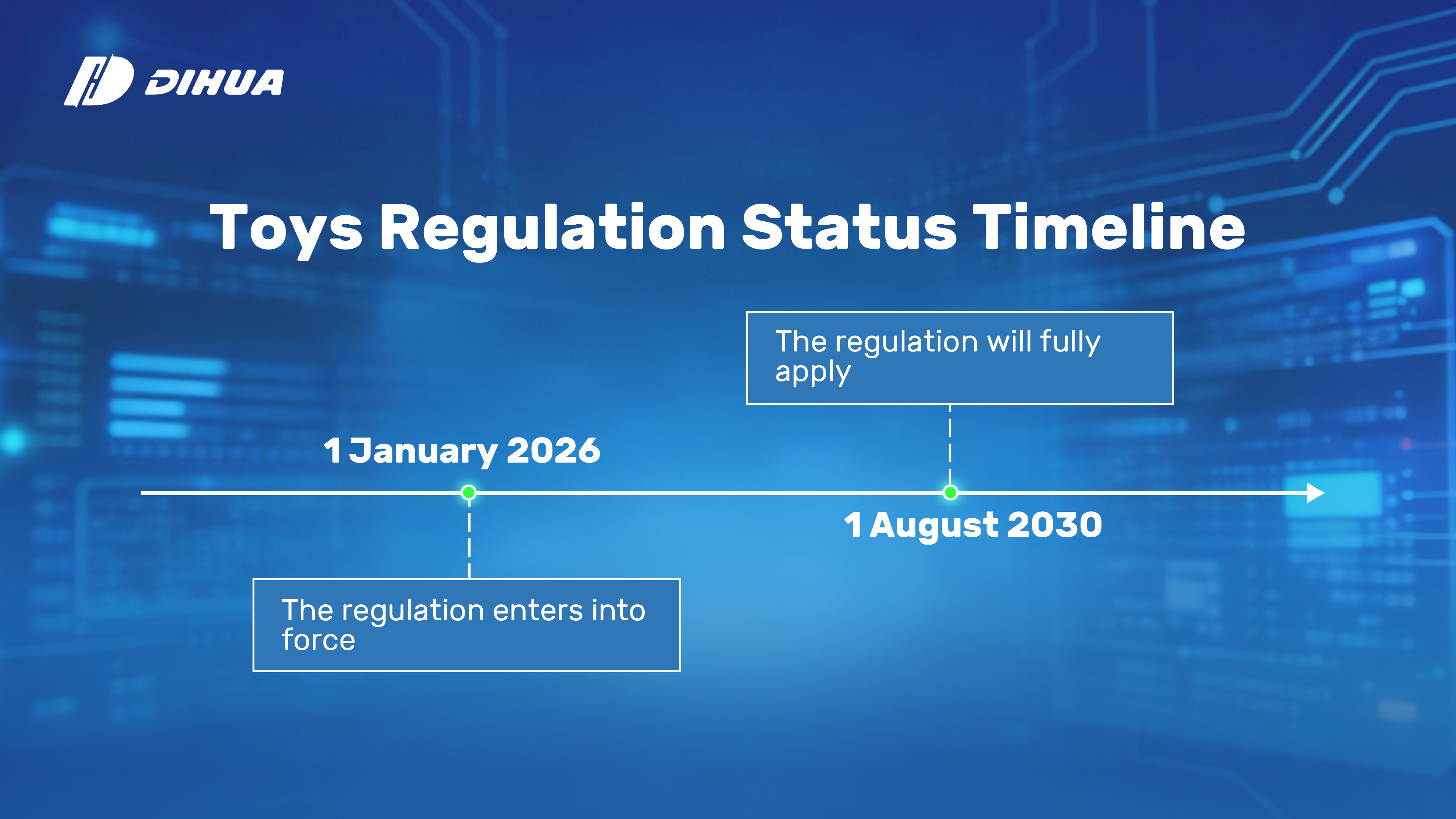
Under the EU Toy Safety Regulation 2025/2509, toys placed on the EU market will be required to carry a Digital Product Passport providing compliance and other required information for the toy. The Regulation entered into force on January 1, 2026, and will fully apply from August 1, 2030. The European Commission has also made clear that all toys will require a Digital Product Passport, with instant access provided through a data carrier.
For private-label and sourcing-led toy retailers, the introduction of the Digital Product Passport signals a shift in compliance management. Instead of focusing primarily on the end result of simply obtaining reports, private-label and sourcing-led toy retailers may increasingly pay closer attention during procurement review, product approval, and go-to-market preparation to whether compliance information flows clearly across different stages, remains consistent throughout the process, and can be readily reviewed when needed.
At the same time, it is important to clarify that, under the current regulatory framework, responsibility for creating the Digital Product Passport still sits primarily with the manufacturer. That said, this does not mean that all related preparation can simply be left to the production stage.
Based on the way the framework is currently being introduced, the Digital Product Passport is still taking shape in practice. In simple terms, it can be understood as an extension of the existing Declaration of Conformity, bringing together information that is currently dispersed across test reports, technical documentation, and labels, and making it accessible externally through a QR code or similar digital access point.
For that reason, the Digital Product Passport is not, in essence, just another standalone document. Rather, it is a more systematic way of organizing existing product information and supply chain data.
Against this backdrop, for a one-stop toy supply chain partner like Dihua—whose core strengths lie in supply chain integration, project coordination, and sourcing services—the more practical priority during the transition period during the pre-implementation window for Digital Product Passports is not to take over the manufacturer’s legal responsibility for creating the Digital Product Passport. It is to help clients organize upstream supply chain documentation earlier, create clearer links between project milestones and supporting documents, and lay a more solid foundation for the future rollout of Digital Product Passport requirements.
As the Digital Product Passport places greater emphasis on structured information, private-label and sourcing-led toy retailers should assess in advance whether their current approaches to compliance document management, product file archiving, and record retention can support clearer review, revalidation, and retrieval later on. For companies with broad product lines and multiple supply chain partners, this type of internal review typically takes time and is often better addressed progressively during the pre-implementation window.
How smoothly the Digital Product Passport can be supported in the future will also depend on whether upstream documentation is submitted in a stable, complete, and consistent manner. Raw material information, test records, component documentation, label content, and technical documentation often come from different suppliers, different factories, and different execution stages. For private-label and sourcing-led toy retailers managing multiple partners and multiple product programs at the same time, defining documentation requirements, handover points, and version expectations earlier can help reduce information gaps and repeated clarification during later review stages.
In this process, the more practical priority for private-label and sourcing-led toy retailers is not to take on the manufacturer’s role in creating the Digital Product Passport in advance. It is to strengthen the foundation for coordinating, checking, and consolidating upstream documentation.
If private-label and sourcing-led toy retailers only begin to systematically review their documentation and internal workflows as the regulation approaches application, issues such as inconsistent file management, incomplete historical records, unclear sample versions, or inconsistent supplier submissions may create additional delays in product review, listing preparation, and internal verification. For companies managing a large number of SKUs while also planning around seasonal launches, using this pre-implementation window to strengthen these foundations earlier will generally help preserve more flexibility in product review and launch timelines.
Dihua is a one-stop toy supply chain partner. Dihua’s core value lies in integrating global sourcing, supplier resources, full-cycle QC, in-house lab support, OEM/ODM development coordination, and an audited factory network to help clients drive smoother coordination across every stage—from product selection, development, and sampling, test preparation and mass production and delivery.
As Digital Product Passport place greater emphasis on information consistency, document accessibility, and process traceability, Dihua can support clients in two practical ways that align closely with its business scope. First, through sourcing and supply chain coordination, Dihua helps clients improve upstream document flow and project visibility. Second, through its in-house lab, full-cycle QC, and OEM/ODM coordination, Dihua helps clients identify potential project risks earlier and maintain clearer links between samples, documentation, and project milestones.
As a supply chain partner, Dihua has long been involved in supplier screening, resource integration, project follow-up, and cross-functional coordination. For private-label and sourcing-led toy retailers serving the EU market, these capabilities are especially relevant during the pre-implementation window for Digital Product Passport.
During the pre-implementation window, private-label and sourcing-led toy retailers need more than suppliers that can simply manufacture a product. They also need to consider whether a supplier demonstrates stronger discipline in document management, sample coordination, test support, and file handover practices. With sourcing teams across multiple cities in China and broad supply chain resources, Dihua can help clients screen and connect with suppliers that are better suited for stable, long-term cooperation.
For private-label and sourcing-led toy retailers managing multiple suppliers and parallel projects, the real challenge is often not whether documents exist, but whether the documents match the correct sample, whether versions remain aligned, and whether changes are clearly recorded. During project execution, Dihua can help clients maintain clearer connections between sample status, specification details, test preparation materials, label content, and related documentation, helping reduce the repeated confirmation work that often arises later from version confusion or fragmented information.
When a project involves sourcing, development, factories, testing, packaging, and delivery preparation at the same time, the foundation of document traceability often comes from process visibility. Through clearer milestone follow-up and cross-party communication, Dihua can help clients identify potential risks earlier, improve information visibility across multi-party projects, and support a more orderly execution process.
Although Dihua does not carry the legal responsibility for creating the Digital Product Passport, its existing capabilities in in-house lab support, full-cycle QC, and OEM/ODM development coordination can still provide practical support to clients as future compliance requirements place greater emphasis on documentation alignment and process traceability.
At the project initiation and early development stages, Dihua can draw on its industry experience, in-house lab support, and project assessment capabilities to help clients identify potential risk points earlier. These may include structural design approaches, material suitability, functional boundaries, label preparation, and differences across market requirements. Earlier visibility into these issues can help reduce the likelihood of repeated revisions, re-submission of samples, or document rework later in the process.
During sample development and test preparation, one of the most common needs for private-label and sourcing-led toy retailers is clarity around which version a current sample relates to, which supporting documents it corresponds to, and whether any subsequent changes have been made. Drawing on its project follow-up capabilities and full-cycle QC experience, Dihua can help clients maintain clearer alignment between samples, specifications, test preparation materials, and related label information, creating a more reliable foundation for later review and document retrieval.
During supplier execution, Dihua’s role is better positioned as one of coordination and support rather than taking over the factory’s legal responsibilities. In areas such as material changes, structural adjustments, sample status, and document updates, Dihua can help clients drive clearer confirmation and recordkeeping across relevant partners, reducing the risk of communication gaps and repeated project back-and-forth caused by disconnected information.
In the later project stages, the challenge for private-label and sourcing-led toy retailers is often whether they are complete, easy to retrieve, and clearly linked to the correct project stage. As part of its service process, Drawing on its service processes, Dihua can help clients organize technical documentation, label content, warning statements, version records, and project files more clearly, creating a stronger foundation for future compliance requirements that are expected to place greater emphasis on documentation consistency and traceability.
During the pre-implementation windowbefore the Digital Product Passport fully applies, private-label and sourcing-led toy retailers can prioritize preparation from two connected directions: strengthening internal document and record management foundations, and improving external documentation coordination across the supply chain. The focus is not simply on collecting more files, but on building a stronger foundation for documentation that is clearer, more traceable, and easier to retrieve, thereby supporting future review processes and laying groundwork for the eventual implementation of the Digital Product Passport.
· Define the management scope of product-level documentation
· Strengthen version control across samples, documents, labels, and project records
· Establish clear checkpoints across development, test preparation, production follow-up, handover, and listing preparation
· Place greater emphasis on document consistency and retrievability during internal review
These efforts can help improve document consistency, reduce errors, and create better alignment between approved product information and later review requirements.
· Clarify supplier requirements for submitting samples, test preparation materials, labels, and project documentation
· Strengthen communication among different partners around document handover, version updates, and information confirmation
· Give preference to suppliers and partner factories that offer stronger cooperation, more standardized documentation practices, and clearer process management
· Select supply chain partners with stronger capabilities in project coordination, quality control support, and supply chain integration
Clearer expectations and earlier coordination can help reduce review risks caused by missing documentation or inconsistent information, while creating a more reliable foundation for aligning with future Digital Product Passport requirements.
For private-label and sourcing-led toy retailers preparing for the EU market, the pre-implementation window is also an appropriate time to reassess the capabilities of their supply chain partners. What deserves priority is not simply whether a partner can deliver quickly, but whether it offers stronger supplier integration, better documentation coordination, greater project visibility, more reliable quality control support, and a sound basis for long-term collaboration.
From this perspective, a one-stop toy supply chain partner like Dihua—with strengths in sourcing, supply chain coordination, full-cycle QC, in-house lab support, OEM/ODM development coordination, and the integration of audited factory resources—is well positioned to help private-label and sourcing-led toy retailers build a stronger foundation during the pre-implementation window. While this does not mean creating the Digital Product Passport in advance, it can help establish a clearer and more practical base for future document alignment, review preparation, and supply chain coordination once Digital Product Passport requirements fully apply.
If you are currently reviewing your preparation priorities for the EU market, you are welcome to visit Dihua’s website(www.dihuatoys.com) and connect with the Dihua team to discuss practical preparation during the pre-implementation window.
We also look forward to meeting you at the 139th Canton Fair (May 1–May 5, 2026) and exploring potential opportunities for further cooperation.
 Hot News
Dihua specializes in sourcing,productdevelopment,production tracking,sales,and service.
Headquarters:
No.1 Leshan Road, Longhu District, Shantou, Guangdong, China
Hong Kong office:
Unit 2401,24/F, Million Fortune Industrial Centre, No.34-36 ChaiWan Kok Street, Tsuen Wan, NT, Hong Kong
Copyright © Shantou Dihua Trading Co.,Ltd. All Rights Reserved Privacy Policy

 EN
EN
 FR
FR
 JA
JA
 RU
RU
 ES
ES