According to data from Markets and Markets, the global TIC market is projected to grow from approximately USD 239.48 billion in 2025 to around USD 282.76 billion by 2030, representing a compound annual growth rate (CAGR) of about 3.4%. This growth is largely driven by tighter regulatory requirements, increased consumer expectations around product safety, and the growing need for manufacturers to operate across multiple markets.
Within the toy industry, parallel multi-market regulations and heightened regulatory scrutiny are placing OEM and ODM projects under dual pressure: increasing compliance risk and rising compliance costs. Today, compliance risks are no longer concentrated solely on product functionality. These risks more often arise from execution-level factors such as structural details, batch-to-batch consistency, and the accuracy of labeling and technical documentation. At the same time, overlapping test requirements across different markets increase the likelihood of repeated testing and corrective actions, driving up overall compliance costs.
For buyers such as brands, importers, and retailers, the ability to identify compliance risks early in the project lifecycle, reduce unnecessary testing cycles, and make informed, controllable decisions upfront has become a key factor in reducing compliance risks and costs.
In an environment where multiple market regulations coexist and oversight intensifies, relying solely on third-party testing during the late stages of a project no longer meets the needs of brands, importers, and retailers seeking to simultaneously manage compliance risks and costs.
To address this, Dihua leverages its in-house laboratory to move compliance evaluation upstream—embedding it throughout project initiation, development, and production stages, which allows potential high-risk compliance paths to be identified while design and execution options are still adjustable. The role of the in-house laboratory is not to replace accredited certification testing, but to reduce unnecessary testing cycles and costly late-stage rework, thereby lowering compliance risk and cost while improving the predictability of time-to-market.
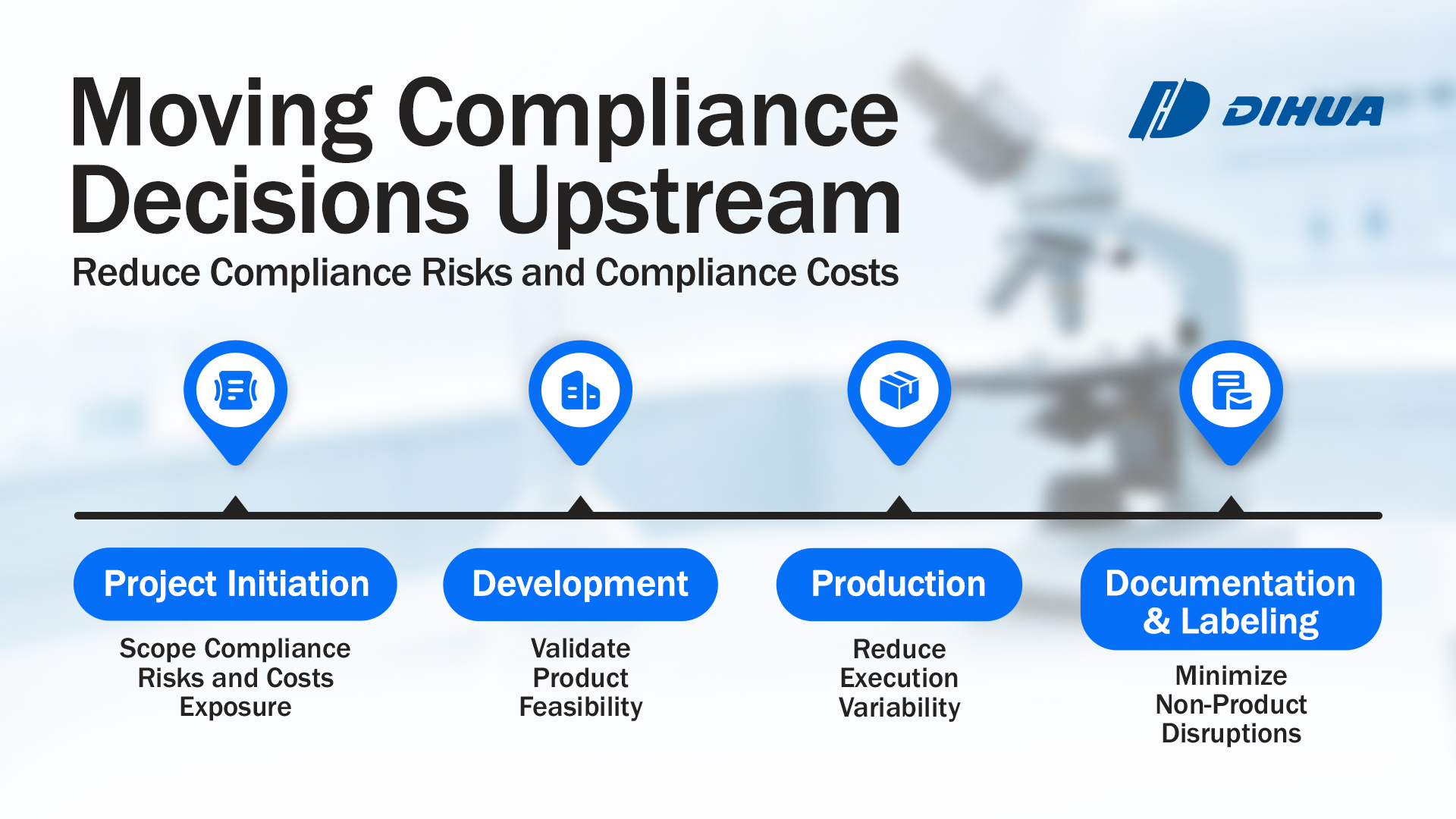
For buyers, the key consideration at the project initiation stage is not whether a project can enter the testing process, but whether the chosen compliance route carries a high likelihood of failure or significant cost exposure.
Through early-stage compliance scoping supported by its in-house laboratory, Dihua conducts early-stage compliance risk scoping and initial screening for the project, aligned with the regulatory requirements of target markets, with a focus on the following risk dimensions:
· Multi-Market Regulatory Risks
Whether the product must comply simultaneously with standards such as EN 71, ASTM F963, and CPSIA, and whether inconsistencies exist across markets in testing requirements or labeling pathways.
· Structural and Functional Risks
Whether the proposed design includes elements that are commonly associated with regulatory failure, such as small parts hazards, projectile mechanisms, magnetic components, sharp edges, or sharp points.
· Material and Restricted Substance Risks
Whether the intended material selection involves PVC, soft plastics, coatings, or inks subject to heightened regulatory scrutiny, as well as potential exposure to restricted substances such as phthalates, heavy metals, and PAHs.
When risk boundaries are clearly scoped before major resources are committed, buyers gain early visibility into whether a project follows a manageable compliance route, which helps reduce wasted development work and testing spend resulting from early directional misjudgments.
Once a project moves into the development and prototyping stage, compliance risks that have not been identified early often surface during formal third-party testing. When this happens, they tend to translate directly into corrective actions, retesting, and associated cost increase.
To reduce trial-and-error costs at this stage, Dihua’s in-house laboratory conducts early-stage verification of proposed design solutions through internal validation, focusing on several key execution-level risk areas:
· Structural Stability and Physical Risks
Whether the design presents small parts hazards, or structural vulnerabilities that are likely to fail in tensile, torque, drop, and similar tests.
· Materials and Key Component Compliance Risk
Whether core materials and critical components have a realistic basis for entering formal chemical testing.
· Functional Implementation and Regulatory Boundary Risk
Whether the specific implementation of sound, light, motorized, battery-powered, or wireless functions aligns with applicable regulatory requirements, including EN 62115 and FCC standards.
When these internal verifications are completed while design adjustments remain feasible, buyers can make targeted refinements without increasing the number of formal testing cycles, thereby reducing the likelihood of downstream test failures and directionally incorrect rework.
During mass production, compliance risk is more often driven by execution variability rather than by the underlying design itself. At this stage, Dihua’s in-house laboratory focuses on whether any changes occur in core materials, structural elements, or manufacturing processes; on critical production steps that are prone to issues such as sharp edges, small-part detachment, or coating defects; and on the consistency between production samples and the samples submitted for testing.
When intervention occurs at key control points, the risk of additional sampling, retesting, or corrective actions arising from batch-to-batch variation is reduced, which supports more stable delivery outcomes and greater predictability in production schedules.
Issues related to labeling, warning statements, and technical documentation are among the most common causes of market-entry delays. Prior to formal testing submissions, Dihua provides parallel documentation and labeling verification, with a focus on reviewing age grading, warning statements, availability of required language versions, alignment between technical documentation and submitted samples, and the completeness of market-access documents such as CE marking and the associated Declaration of Conformity (DoC), as well as the Children’s Product Certificate (CPC).
When compliance risks and cost exposure points are identified proactively across each stage of the project lifecycle, Dihua’s in-house laboratory enables buyers to treat testing, inspection, and certification (TIC) as a planned and controllable part of project execution rather than an unpredictable back-end cost, which supports more stable and predictable market entry across multiple regions.
The value of Dihua’s in-house laboratory lies not in the volume of testing it performs, but in whether it helps brands, importers, and retail channels that need to control compliance risk and compliance cost reduce risk exposure early in the project lifecycle and make compliance spend more predictable. In an environment where multiple market regulations apply in parallel, this capability has become an increasingly important factor for brands, importers, and retail channels when evaluating OEM/ODM partners.
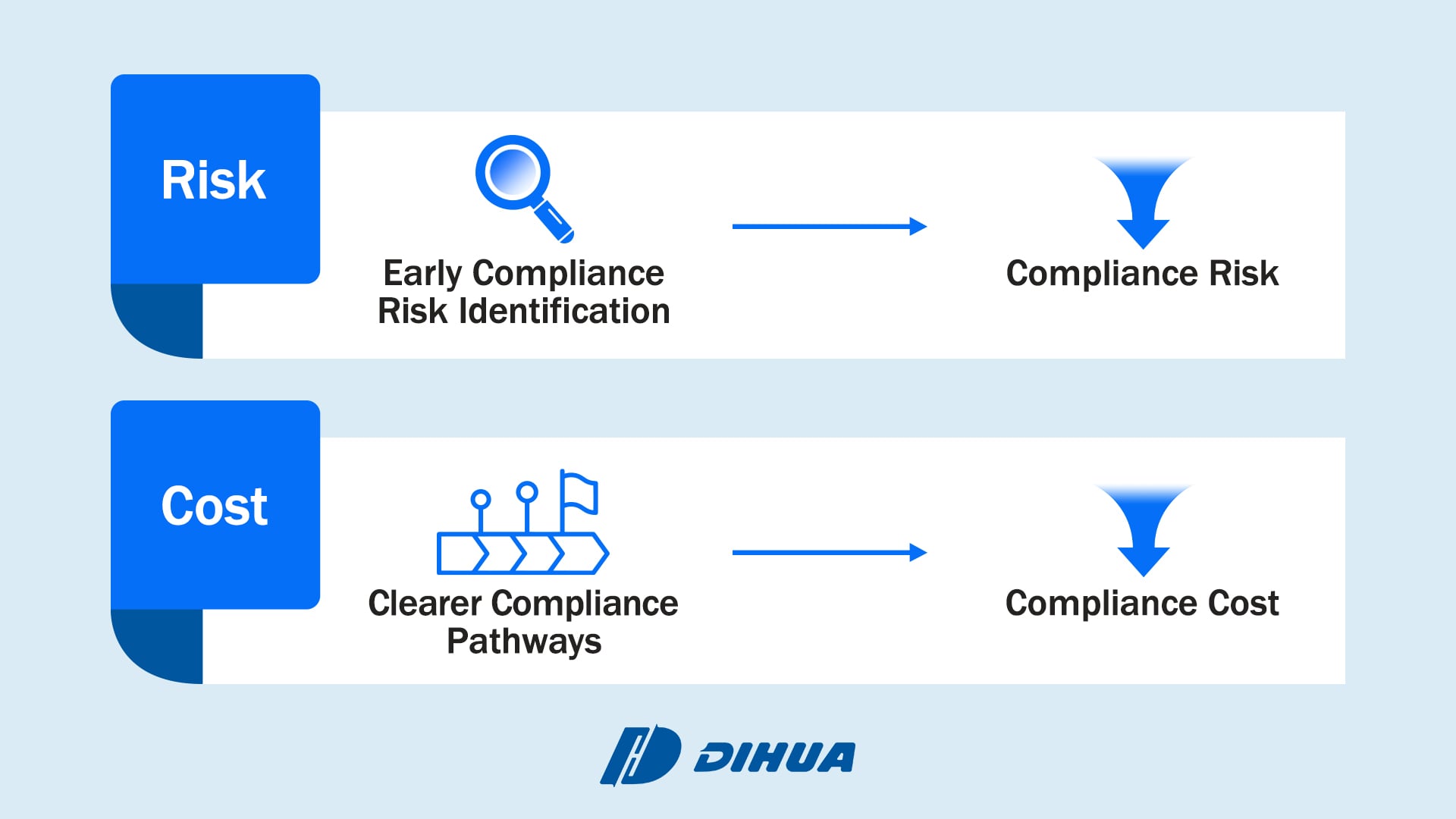
Through early-stage compliance scoping and internal verification supported by Dihua’s in-house laboratory, buyers focused on managing compliance risk and cost can assess the viability of a given compliance route during project initiation and early development. This enables the timely identification of high-risk design, material, or structural choices, reducing the likelihood that such options are carried forward into development, mass production, or formal third-party testing.
During the production stage, earlier intervention in execution consistency further helps reduce the risk of additional sampling, retesting, or product withdrawal resulting from material substitutions, process adjustments, or batch-to-batch variation. As a result, compliance risk is no longer concentrated at the end of the project, but instead distributed and managed at stages where adjustments remain feasible.
In toy projects, increases in compliance cost are often not driven by the testing itself, but by corrective actions, retesting, and repeated investment following test failures. By identifying high-probability failure points before formal third-party testing, Dihua’s in-house laboratory helps buyers reduce test failure rates and limit repeated testing and rework, thereby lowering overall compliance costs.
At the same time, testing schedules and market-launch windows can be confirmed earlier, further reducing additional compliance and operational costs caused by schedule adjustments, inventory misalignment, or last-minute changes. For channels that rely on seasonal launches and inventory turnover, this reduction in compliance cost delivers clear and practical value.
From a channel perspective, an in-house laboratory represents a supplier’s system-level capability in compliance, cross-stage coordination, and shared risk management—rather than a standalone testing resource. By proactively identifying and controlling compliance risks across each stage of the project lifecycle, Dihua helps reduce rework and delivery uncertainty, enabling buyers to achieve more stable cost structures and predictable market-entry timelines. This is what positions Dihua as a partner suited for long-term collaboration.
For brands, importers, and retail channels seeking to control compliance risk and cost uncertainty, the key consideration is how early compliance assessment is integrated into project decision-making. Introducing compliance support at the project initiation and early development stages allows potential high-risk pathways to be identified while cost structures and design options remain adjustable—reducing the likelihood that issues later escalate into testing delays, scheduling disruptions, or inventory pressure.
The earlier compliance considerations are brought into the process, the greater the opportunity to maintain controllable risk exposure, predictable cost planning, and stable market-entry timelines across multiple regions.
To learn more about how Dihua’s in-house laboratory supports project initiation assessment, development-stage verification, and execution consistency control, we invite you to connect with our team via www.dihuatoys.com to evaluate how this approach may align with your current or planned projects.
 Hot News
Dihua specializes in sourcing,productdevelopment,production tracking,sales,and service.
Headquarters:
No.1 Leshan Road, Longhu District, Shantou, Guangdong, China
Hong Kong office:
Unit 2401,24/F, Million Fortune Industrial Centre, No.34-36 ChaiWan Kok Street, Tsuen Wan, NT, Hong Kong
Copyright © Shantou Dihua Trading Co.,Ltd. All Rights Reserved Privacy Policy

 EN
EN
 FR
FR
 JA
JA
 RU
RU
 ES
ES