In many building block product line strategies, road baseplates are often classified as entry-level SKUs during the initial price-point screening process due to their relatively low unit price and limited visual impact.
However, from a product line perspective, road baseplates function more like evergreen expansion SKUs: they provide a low entry point for consumers to enter a themed building system, while future expansion, replenishment, and cross-selling opportunities are continuously supported by related SKUs.
According to global toy industry data released by Circana in January 2026, the Building Sets category in the G12 markets grew 18% year over year in retail sales in 2025, marking the sixth consecutive year of growth. LEGO also transitioned its road baseplates from flat plates to brick-built Road Plates in 2021, positioning road baseplate systems as scene expansion components within product line planning.
However, overall category growth does not mean every road baseplate is worth long-term replenishment planning. Whether a road baseplate deserves a place in a product assortment depends on its role within the product line, actual end-user feedback, and whether it can pass evaluation throughout the product selection and sourcing process.
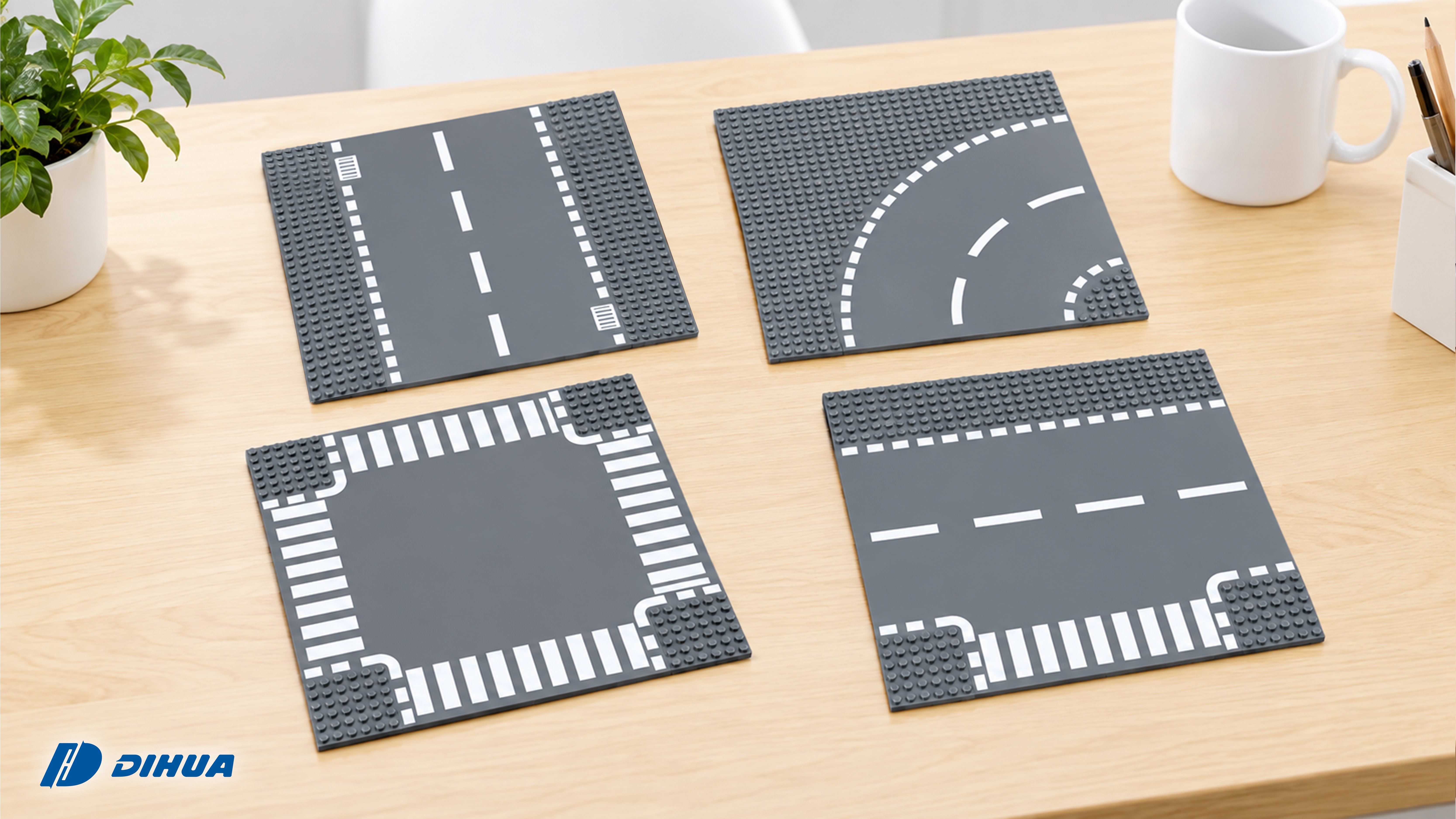
The value of road baseplates as a product line expansion entry point does not come from complex product functions, but from their ability to establish a basic city-building scenario and support further expansion and bundled sales through related SKUs.
As a foundational module for city-themed building sets, road baseplates connect buildings, vehicles, minifigures, and scene accessories, creating a structure that supports continuous expansion. A basic road baseplate SKU can serve as the starting point of a city-building scenario, while future purchases can be supported through related products, including:
· Expansion of road layouts such as curves, intersections, parking areas, and bridges
· Themed scenarios such as fire rescue, emergency services, and construction scenes
· Accessories such as toy vehicles, road signs, street lights, and trees
For toy buyers, the sourcing value of road baseplates lies in driving related product sales within the product line, rather than relying on price reductions to encourage repeat purchases. Therefore, when planning a building block product line, road baseplUse separate plastic bags or foam dividers for mixed-SKU packing to prevent damage and confusion. ates are better evaluated as long-term expansion SKUs rather than standalone products.
End-user feedback helps buyers identify potential issues with road baseplates in areas such as print performance, connection compatibility, structural stability, batch consistency, and packaging management.
These issues may affect the user experience, after-sales handling costs, and consistency during future replenishment. Therefore, they should be carefully evaluated during the sourcing stage.
| Common End-User Issues | Potential Quality Risks |
| Road patterns are unclear, making it difficult for consumers to understand the product usage | Insufficient print quality or weak scene communication |
| Printed patterns fade or peel off after repeated use | Insufficient ink adhesion or wear resistance |
| Multiple baseplates become misaligned or uneven after connection | Insufficient control of stud tolerance, baseplate warpage, or edge height difference |
| Noticeable color differences occur between different production batches of the same product | Unstable pigment batch control or printing process consistency |
| Product contents do not match the items received |
Inconsistency between BOM, packaging artwork, and carton packing management |
Start by defining the target channel and price band, then evaluate whether a specific SKU fits the product line.
Different channels have different priorities:
· Retail channels: Packaging presentation, price acceptance, and shelf display performance
· E-commerce channels: Bundle value, visual presentation, and consumer understanding cost
· Educational / themed channels: Repeat building capability and scene expansion potential
Based on the defined price band, road baseplates suitable for inclusion in a product line typically have the following five characteristics:
Different combinations serve different product positioning:
① Basic / expansion sets: Single straight road plates or straight road combinations
② Vehicle-focused SKUs: Straight roads + curved roads
③ City-building sets: Straight roads + curves + T-junctions + cross intersections
④ Educational / themed sets: Road systems combined with buildings or scene accessories around transportation or community themes
⑤ Bundle sales: Straight road plates combined with vehicles, buildings, or minifigures
Key evaluation points include:
· Accurate stud spacing and alignment
· Connection strength suitable for repeated building by children
· Multiple plates should align properly when connected
Large thin-wall injection molded parts may experience issues such as warpage, sink marks, uneven thickness, or edge height differences, which can affect connection performance, vehicle movement, and display stability.
Single-piece flatness, multi-piece connection performance, and dimensional stability after long-term storage should all remain consistent.
Evaluate whether:
· Lane markings, intersections, and parking spaces effectively strengthen the city-building structure
· Road width, curves, and markings match vehicle proportions and intended play scenarios
The product should clearly define:
· Plate types and quantities
· Single-piece dimensions and combination range
· Compatible building systems
· Whether accessories are included
· Recommended age range
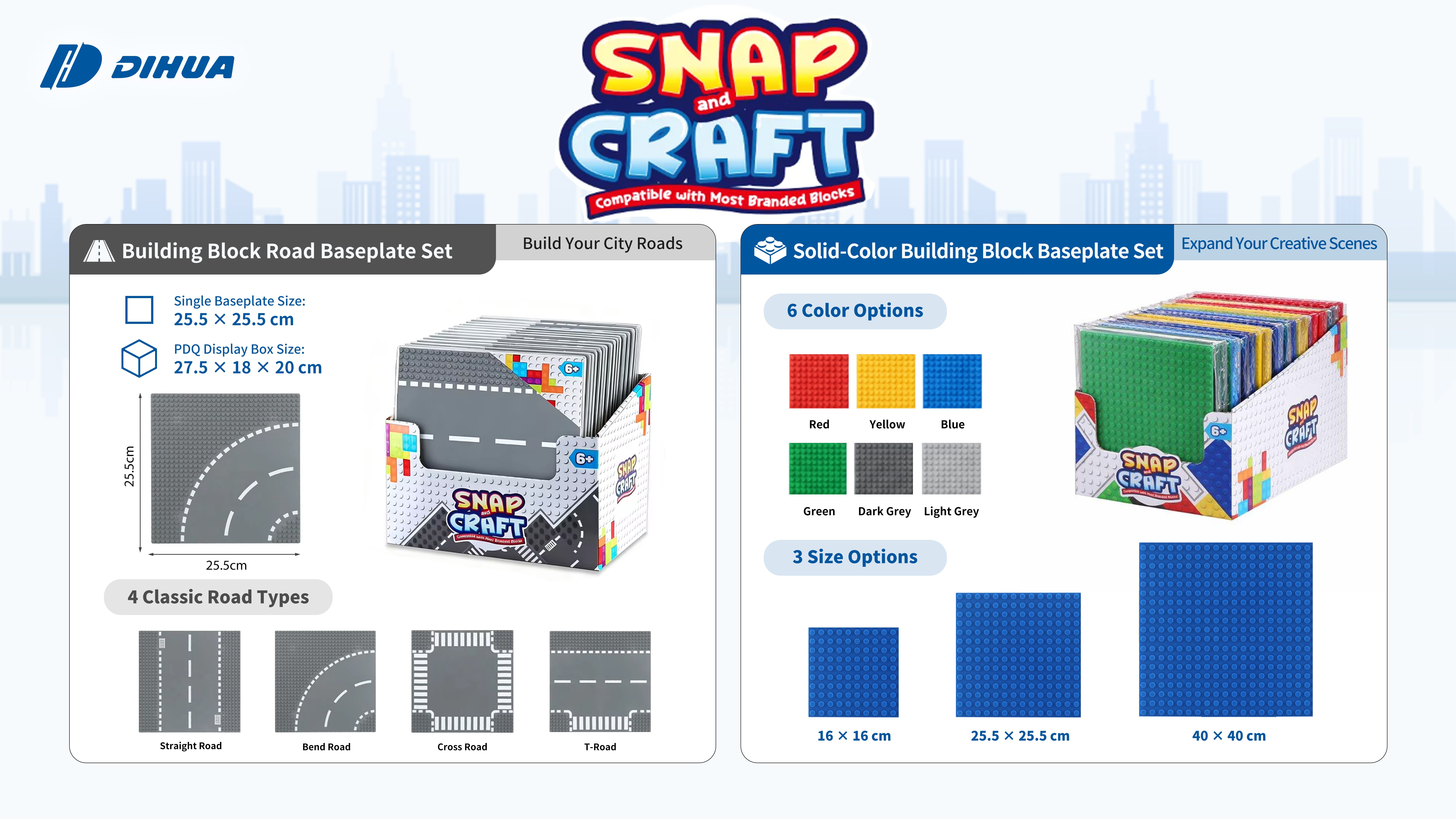
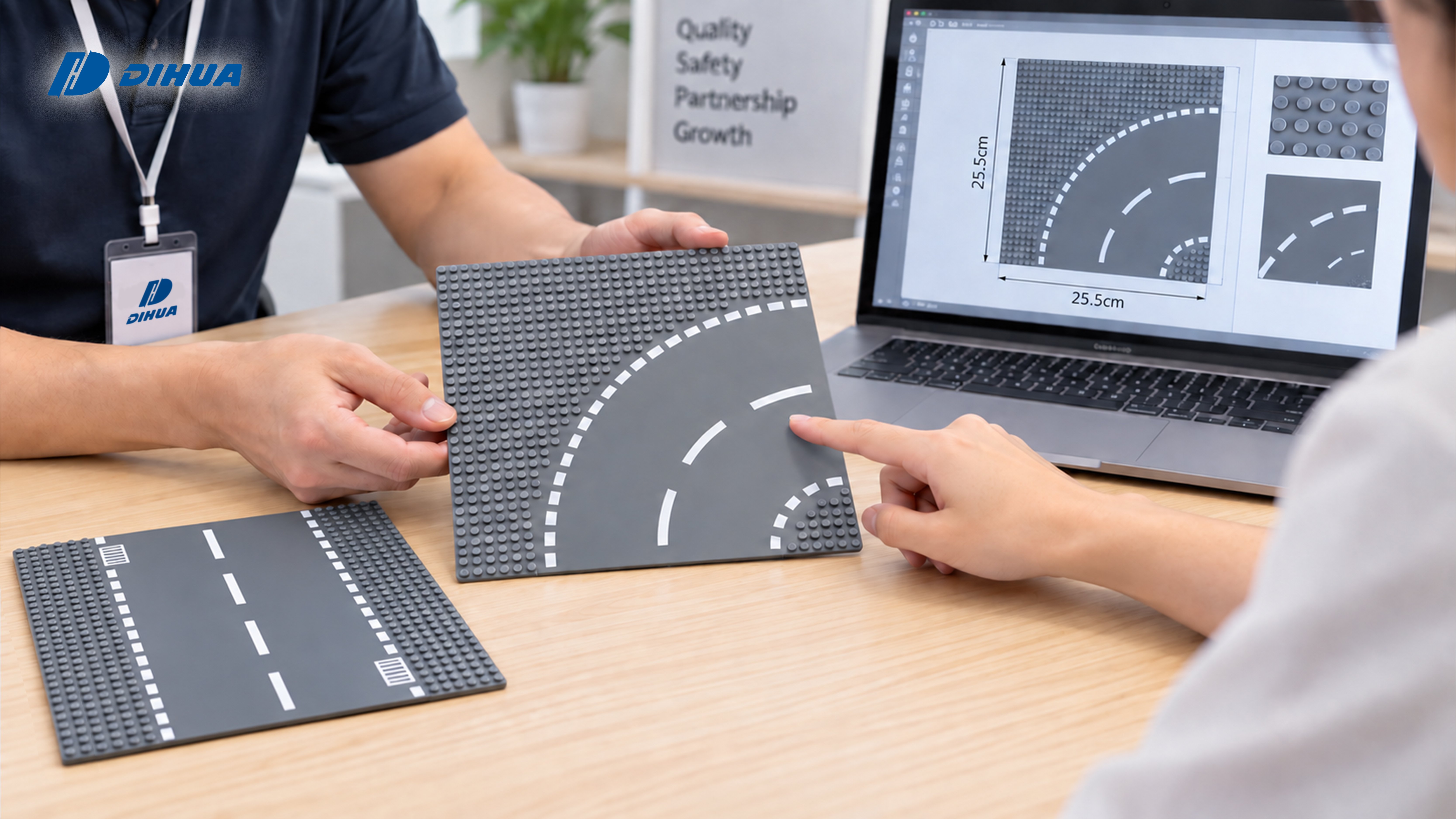
The Dihua Snap & Craft series is built around the city transportation theme, using 25.5 × 25.5 cm road baseplates to create urban road networks, supported by solid-color baseplates in 6 colors and 3 sizes for further scene expansion. Through optimized baseplate combinations, attractive PDQ display packaging, and compliant compatibility labeling, Dihua helps buyers build building block baseplate product lines with higher sell-through potential and stronger cross-selling opportunities.
Dihua Snap & Craft Road Baseplate Set integrates four core road types: straight road, band road, cross road, and T-road. Combined with scenario-based printing such as zebra crossings, lane markings, and parking spaces, the system fits city-building play and vehicle scenarios, helping drive related sales of building block vehicles and construction sets.
The 25.5 × 25.5 cm road baseplate establishes the core urban road scenario while connecting seamlessly with the solid color baseplate series (mixed packs in red, yellow, blue, green, dark gray, and light gray; available in three sizes: 16 × 16 cm, 25.5 × 25.5 cm, and 40 × 40 cm). This allows buyers to plan complete scene-building assortments and create a tiered product range.
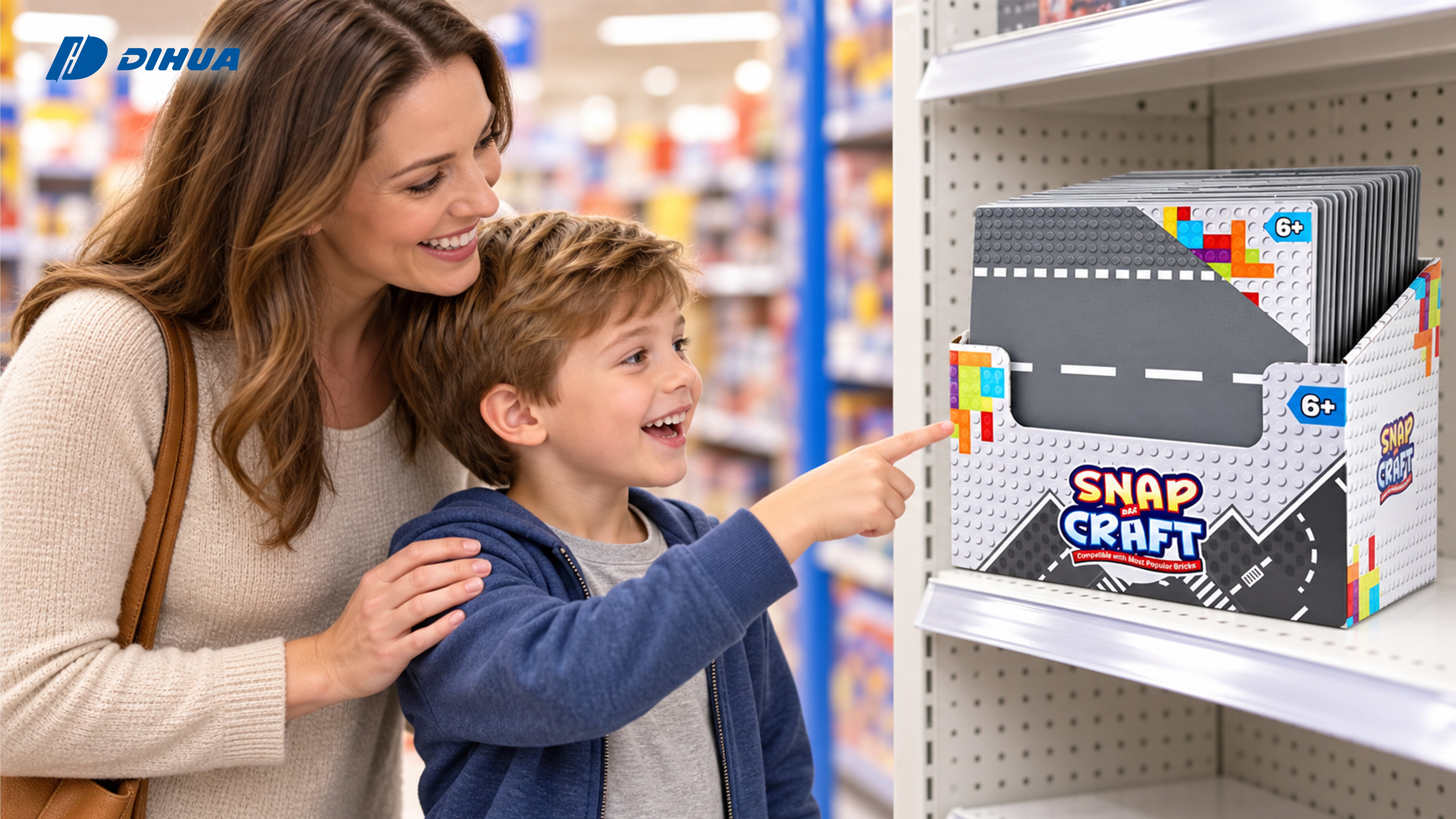
The open-style PDQ display box (approx. 27.5 × 18 × 20 cm) stores baseplates vertically, allowing consumers to clearly see the printed patterns and connection surfaces. The packaging clearly shows single-piece dimensions and the 6+ age recommendation. Without secondary unpacking, products can be directly displayed at checkout counters or main shelves, improving visibility and encouraging add-on purchases.
The product uses the standardized statement Compatible with Most Branded Blocks to communicate compatibility without displaying sensitive brand names or logos. This provides clear product positioning while maintaining compliant wording flexibility for international customs clearance and packaging requirements across different markets.
For evergreen expansion products, the first shipment is only the starting point. The real sourcing challenge is maintaining consistent quality across multiple shelf cycles and production batches.
· Require suppliers to provide stud diameter tolerance ranges and testing methods, and include them in the quality agreement.
· Conduct repeated connection and removal tests with same-size building blocks from at least two major brands.
· Check stud alignment when connecting multiple baseplates.
· Require suppliers to provide flatness data and measurement methods for individual baseplates.
· Use feeler gauges to measure height differences at connection seams between multiple plates.
· Conduct rechecks after storage periods to verify dimensional stability.
· Conduct repeated wear tests using methods such as rubber abrasion and 3M tape testing.
· Assemble multiple baseplates into a complete road layout and verify that pattern connections remain natural and consistent.
· Require suppliers to provide batch color difference reports and define acceptable ΔE control ranges for both within-batch and between-batch variation in the quality agreement.
· Reviewing pigment batch management processes can help identify root causes more effectively than relying only on test reports.
· Standards such as CPSIA, EN 71, ASTM F963, and AS/NZS ISO 8124 are applicable to plastic building block SKUs for children's channels.
· Different markets, including the US, EU, Canada, and Australia, require corresponding compliance documentation.
· Plastic components accessible to children require testing for phthalate migration and heavy metals.
· Applicable standards and testing items should be confirmed according to the latest official requirements of the target market at the time of procurement.
· Ensure internal supports in color boxes provide sufficient protection against impact during transportation.
· Confirm that plate types, quantities, and product contents match across the packaging, instruction manual, and listing information.
· Use separate plastic bags or foam dividers for mixed-SKU packing to prevent damage and confusion.
· Review supplier quality control procedures, including IQC (Incoming Quality Control), IPQC (In-Process Quality Control), FQC (Final Quality Control), and OQC (Outgoing Quality Control).
· Define AQL sampling levels in written quality agreements.
· Confirm whether third-party inspection (such as BV, SGS, or TÜV) is required before bulk production release.
For building blocks and road baseplates targeting the EU market, buyers should pay attention not only to EN 71 and CE marking but also to GPSR (General Product Safety Regulation). Effective from December 13, 2024, GPSR applies to all non-food consumer products sold in the EU. It requires economic operators (manufacturers, importers, and distributors) to have an EU Responsible Person, display Responsible Person information on products or packaging, and comply with online marketplace registration requirements.
For road baseplate buyers, this means supplier evaluation should go beyond requesting EN 71 test reports. Buyers should also confirm whether suppliers can provide EU Responsible Person information and GPSR compliance support. Otherwise, products may face listing restrictions on EU platforms from 2025 onward. This is a key compliance factor that should be included in product sourcing evaluations.
With the increasing adoption of STEAM and construction-based learning programs, demand for repeatable building and standardized scene components is rising. Road baseplates are expanding from retail accessories into foundational components for educational building sets, requiring standardized specifications, scalable replenishment, and institutional-level durability.
Multi-brand building system combinations have become a common consumer practice, while cross-border platforms are becoming stricter in reviewing Compatible with claims. Brand-neutral descriptions and verifiable physical compatibility testing are expected to become standard compliance practices.
Although ISCC certification and bio-based plastics represent longer-term industry directions, GRS (Global Recycled Standard)-certified Recycled ABS has become one of the most practical and widely applicable carbon-reduction requirements for traditional retail channels in Europe and North America.
Dihua’s long-term manufacturing partners are fully equipped with GRS certification capabilities and complete traceability systems, helping toy buyers meet sustainability audit requirements from major retailers. However, the recycled material ratio can directly affect road baseplate flatness (warpage control) and ink adhesion. Through precision injection molding processes and pre-production sample validation, Dihua ensures both sustainability goals and product quality requirements are achieved.
Related online purchases including vehicles,roads and buildings are making product combinability an important factor influencing listing conversion. Evaluation of individual baseplate SKUs is gradually shifting toward the ability to propose complete combinations of baseplates, scene accessories and vehicles.
If you are planning city-themed building blocks, construction sets, toy vehicles, STEAM educational products, or seasonal gift sets, feel free to contact Dihua. By providing your target market, channel positioning, price band, plate combinations, printing versions, set scale, and compliance requirements, Dihua can provide SKU recommendations, sample schedules, and preliminary quotations to help you move from one-time trial orders toward long-term supply partnerships across multiple retail cycles.
Q1: Are 25.5 × 25.5 cm road baseplates compatible with all major building block brands?
International compatible building block systems commonly use standardized specifications, and road baseplates can be connected with many major brands using corresponding dimensions. However, actual compatibility still requires physical verification. Buyers are recommended to request samples from suppliers and complete hands-on connection tests before procurement.
Q2: What is the acceptable color difference range for printed road baseplates in mass production?
There is no industry-wide mandatory range. In most cases, the acceptable range is agreed upon between buyers and suppliers based on channel positioning. Seasonal gift sets and branded channel SKUs usually require stricter standards. It is recommended to define the agreed ΔE tolerance range in the quality agreement.
Q3: Do road baseplates with printed patterns require compliance testing for the EU and North American markets? What support can Dihua provide?
Required safety testing depends on the target market and customer requirements. Dihua currently has relevant test reports for the European market and can cooperate with buyers to arrange third-party testing for other markets.
· European Market: Road baseplates and surface printing materials have relevant test reports such as EN 71 and REACH. Dihua can also provide CE documentation and Declaration of Conformity (DoC). Packaging can include responsible party information and product traceability details according to GPSR requirements.
· North American Market: Product materials are controlled according to requirements such as ASTM F963 and CPSIA. Dihua can cooperate with buyers to submit products for testing through third-party organizations including SGS, TÜV, and BV.
· Customer-Specific Requirements: If buyers have designated standards, laboratories, or testing items, Dihua can provide samples, material documentation, and production support accordingly.
 Hot News
Dihua specializes in sourcing,productdevelopment,production tracking,sales,and service.
Headquarters:
No.1 Leshan Road, Longhu District, Shantou, Guangdong, China
Hong Kong office:
Unit 2401,24/F, Million Fortune Industrial Centre, No.34-36 ChaiWan Kok Street, Tsuen Wan, NT, Hong Kong
Copyright © Shantou Dihua Trading Co.,Ltd. All Rights Reserved Privacy Policy

 EN
EN
 FR
FR
 JA
JA
 RU
RU
 ES
ES