City service vehicle toys cover a wide range of categories, including fire trucks, police vehicles, ambulances, garbage trucks, and other role-based vehicles. For toy retailers and wholesalers, this variety creates opportunities to expand SKU selections quickly. However, a larger number of vehicle types does not necessarily mean a stronger product assortment.
When multiple SKUs share similar functions, target ages, and play experiences, they may compete for the same budget allocation, shelf space, and inventory resources. This can also increase complexity in SKU management, inventory planning, and replenishment decisions.
Therefore, city service vehicle toy assortment planning should go beyond simply asking “Which vehicle category is still missing?” Toy buyers need to evaluate whether each SKU serves a clear and differentiated role in terms of age positioning, play experience, and product value.
Instead of organizing assortments only around vehicle categories, this article explores city service vehicle toy planning from three key perspectives: age-based segmentation, play experience, and compliance. By defining clearer SKU roles and reducing functional overlap, toy buyers can build a well-structured and balanced city service vehicle toy assortment.
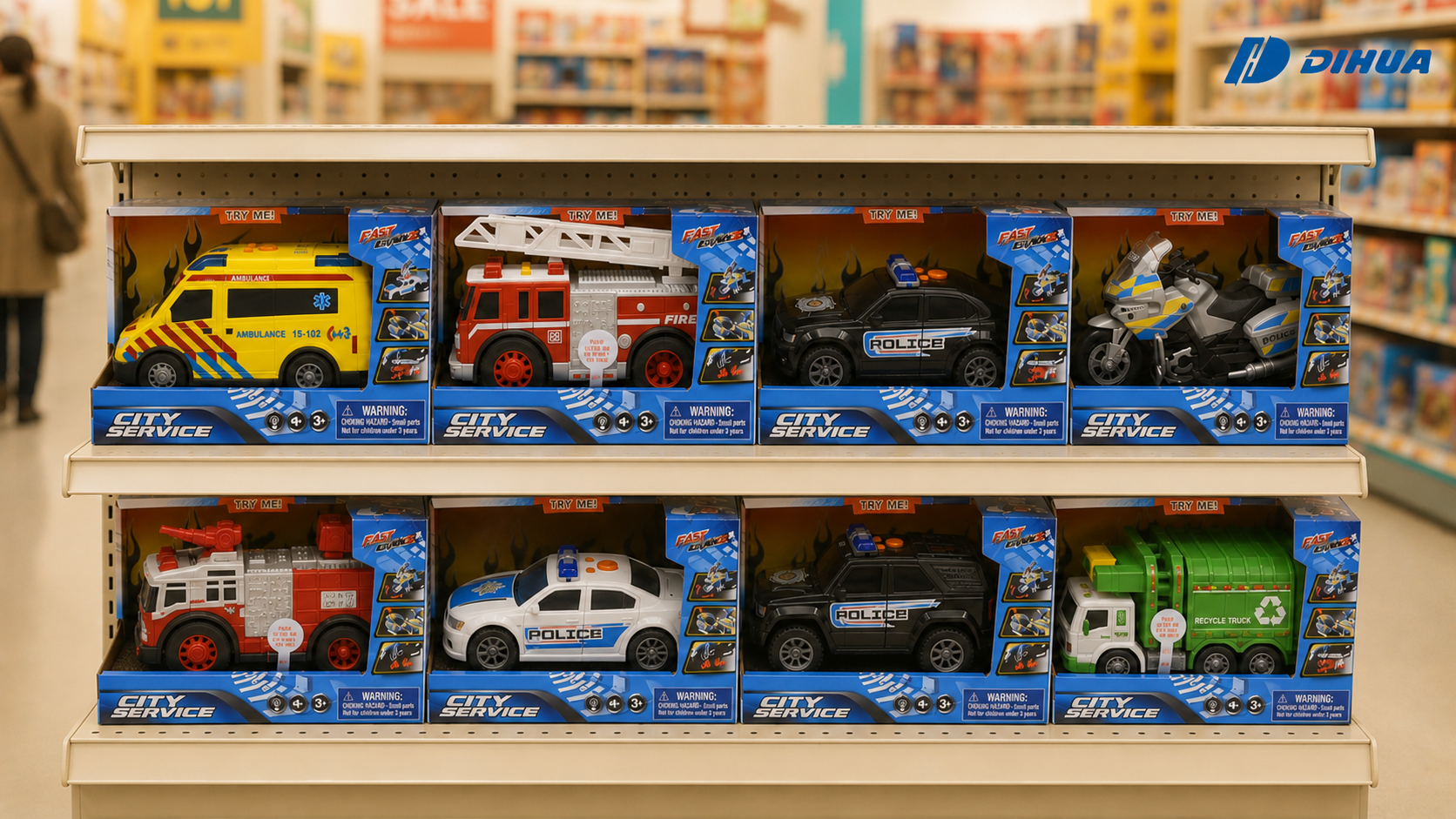
When evaluating city service vehicle toys, buyers can define SKU roles through three core dimensions: age positioning, functional features, and price tiers. Instead of selecting products based only on vehicle appearance, buyers can determine which product role each SKU should fulfill within the overall assortment.
Based on these dimensions, city service vehicle toys can be structured into four clear SKU roles:
For entry-level SKUs designed for ages 1.5–3, play functions can remain simple to match young children’s operation abilities and early interaction needs. Common features may include push-and-go movement, basic rolling play, and gentle light or sound functions.
A common sourcing misconception is that products for younger children should always have lower prices because their play functions are relatively simple.
In reality, toys designed for younger age groups are often subject to stricter safety requirements under standards such as ASTM F963 and EN71. These products require closer attention to small parts safety, mechanical structures, material selection, and component reliability. Safety-focused solutions such as larger component designs, ultrasonic welding, and safer material choices can also increase manufacturing complexity and production costs.
Therefore, entry-level SKUs should not be positioned based only on functional complexity. Even with simpler play patterns, safety structures, material selection, and manufacturing requirements can contribute to a higher cost structure. These products are often better positioned through clear age targeting and stronger perceived product quality to support mid-to-high retail price points.
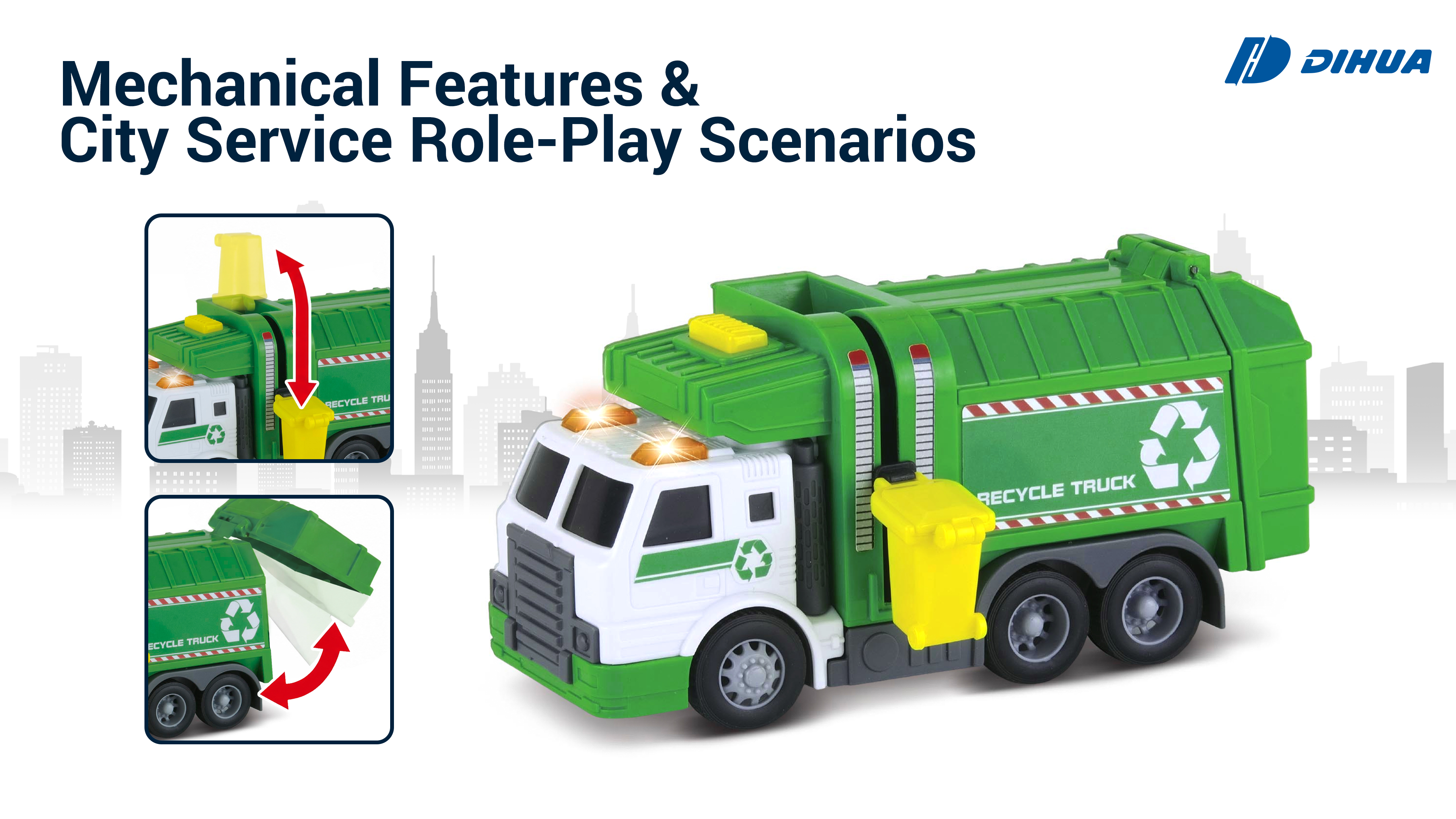
For the 3–6 age group, the key opportunity lies in creating clear SKU differentiation through mechanical features and occupational role-play scenarios.
For example, fire trucks can include water-spraying functions or 360° rotating ladders, while garbage trucks can feature manual lifting mechanisms and movable trash bins. Combined with figures and road accessories, different vehicle types can provide distinct interaction experiences rather than simply changing the vehicle appearance.
Compared with electric or multi-channel remote control products, mechanical play features can help reduce functional overlap within the same product series while keeping configurations and costs more focused. This allows toy buyers to build core city service vehicle SKUs across categories such as fire rescue, sanitation, and emergency services within a relatively stable price tier.
For preschool children, basic push-and-play functions or simple mechanical features may provide limited room for further experience upgrades. Higher-level products often need to create new SKU value through electric drive systems, multi-channel remote control, or independent function controls.
Features such as motorized grabbers, all-direction movement, remote-controlled mechanical structures, or independent sound controls can upgrade play from manual operation to multi-action control. At the same time, motors, remote control modules, power systems, and related mechanical structures also influence BOM costs and sourcing considerations.
Therefore, the key question for advanced SKUs is whether the added features create meaningful control differentiation and support a higher target retail price. Simply adding electronic components without creating a new play experience may increase cost while leaving the SKU role unclear.
For buyers, these products are better considered as flagship premium SKUs within a city service vehicle assortment. Selecting a limited number of models with clear control differentiation can help create a higher functional tier, expand price range coverage, and strengthen premium positioning within the overall assortment.
After completing age, function, and price segmentation, buyers should further define SKU roles through product size and packaging formats.
For example, large-scale 1:16 realistic vehicles can be positioned in window gift boxes with larger product visibility, making them suitable for end-cap displays or key retail placements. Smaller handheld vehicles can use more compact packaging, reducing the shelf space required per unit and making them suitable for standard shelf areas, impulse-purchase sections, or lower price points.
Toy buyers should first define the shelf function each product needs to serve, then use size and packaging formats to create clear differentiation:
· End-cap Display SKUs: Larger vehicle size and stronger visual impact to attract attention and support key merchandising locations.
· Core SKUs: Balanced size, functionality, and pricing to serve as the main assortment layer.
· Compact Supporting SKUs: Smaller formats and efficient packaging to cover additional shelf positions and price points.
This differentiated approach helps reduce internal competition among SKUs with similar price points and product sizes, allowing packaging and product dimensions to become an active part of assortment planning.
Overall, a well-structured city service vehicle toy assortment should create clear SKU layers: younger-age products build value through safety-focused structures and simple interaction; 3–6 age products serve as core price-tier drivers through mechanical and scenario-based play; 6+ products expand functional and price ceilings through electric and remote-control features; and size and packaging formats define different merchandising roles across channels.
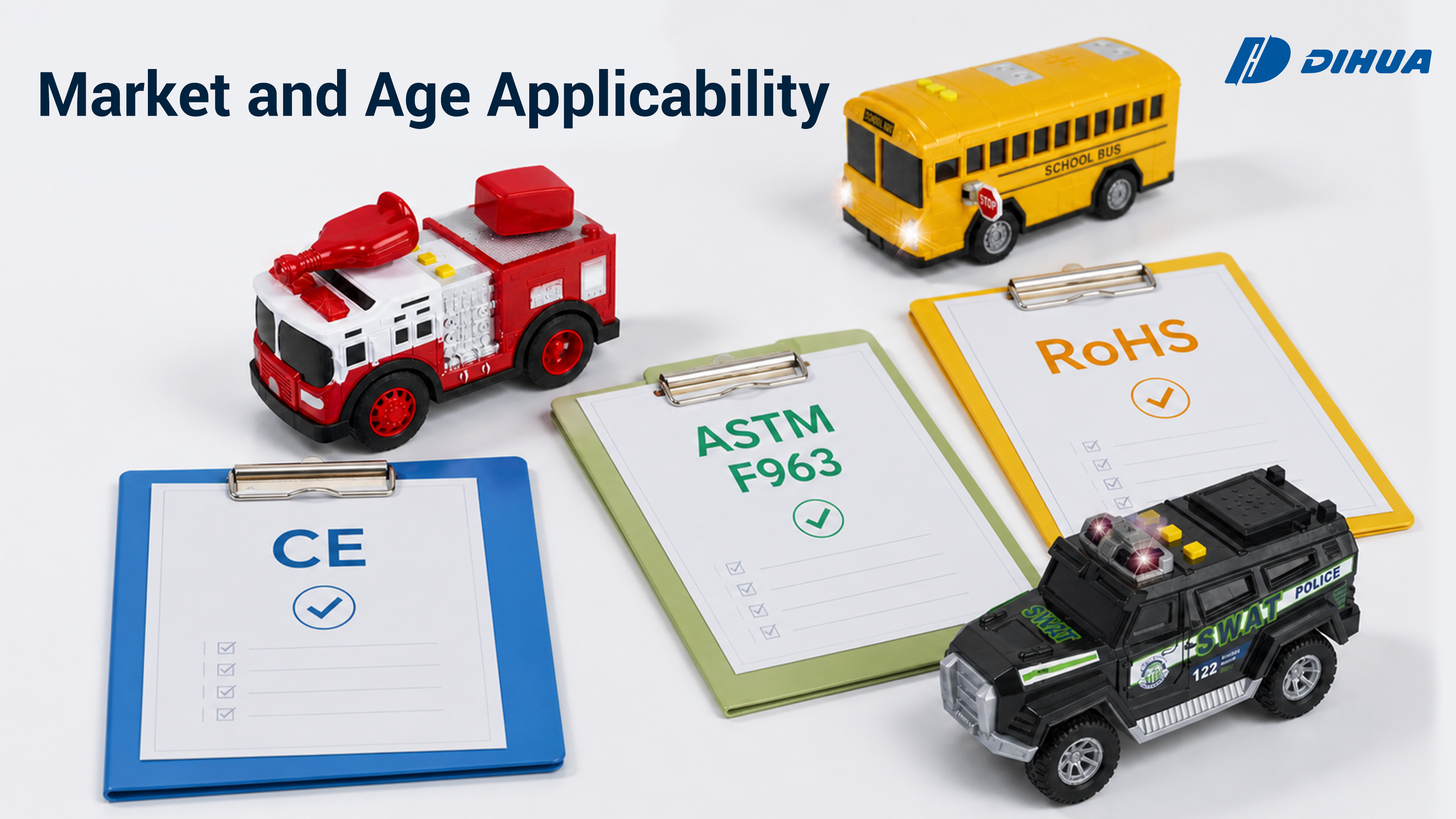
After completing age, function, price-tier segmentation and packaging, toy buyers still need to verify whether existing testing documentation truly applies to the target market, product version, and actual functional configuration of the selected SKUs.
The same city service vehicle toy may be subject to different regulatory frameworks and testing requirements when entering markets such as the United States, the European Union, or other regions. Age grading can also influence which compliance items need further confirmation.
Taking the U.S. market as an example, ASTM F963 covers multiple toy safety requirements, but not every requirement applies to every product. The applicable requirements still need to be evaluated based on the specific toy category and age group.
Therefore, buyers should first verify whether the target market, age grading, applicable standards, and standard versions referenced in the test reports align with the current project. This helps reduce the risk of incorrectly assuming that existing testing documentation can be directly applied to a new order.
After confirming that testing documentation is applicable to the target market, toy buyers should further verify whether the tested samples in the reports match the actual SKUs being purchased.
A city service vehicle toy with the same appearance may have multiple versions, such as basic friction-powered models, light-and-sound versions, electric versions, or different battery configurations. If the existing report covers only the basic version, but the new order adds electronic modules, accessories, or changes key materials, buyers need to further confirm whether the original documentation still covers the updated product configuration.
Therefore, procurement teams should pay particular attention to whether the specific SKU model and material composition are consistent with the samples evaluated in the test reports.
Matching the product version with existing documentation does not necessarily mean that all product functions have already been evaluated.
Different configurations, such as light-and-sound functions, battery-powered systems, motorized structures, or wireless remote-control features, may involve different testing requirements.
Therefore, buyers should review each configuration separately, including basic mechanical versions, light-and-sound versions, electric versions, and remote-control versions. The key consideration is whether testing requirements related to newly added functions are already covered by the existing documentation.
For multi-SKU projects, buyers should avoid using a general statement such as “the product series already has test reports” as the only basis for evaluation.
Instead, buyers can create an SKU-based testing documentation checklist and classify each SKU status into different categories, such as:
· Documentation applicable to the current SKU version
· Documentation requiring further confirmation
· Additional testing or updated documents required
This approach is especially suitable for projects involving multiple city service vehicle SKUs, such as fire trucks, garbage trucks, and police vehicles. Even when several products share similar basic structures, buyers can clearly identify which documents apply to the current version and which items still require additional verification.
From a sourcing perspective, toy testing and compliance requirements should be considered as part of the SKU evaluation process rather than treated as a separate final inspection step before shipment. The earlier buyers complete documentation matching across market requirements, age grading, product versions, and functional configurations, the easier it becomes to identify potential testing and documentation gaps before sample approval and mass production.
After completing age segmentation, functional positioning, and testing documentation review, buyers still need to determine the final SKU assortment based on actual sourcing conditions.
First, priority should be given to SKUs that serve clearly different roles across age groups, play experiences, and price tiers, while avoiding repeated investment in products with highly similar positioning. Buyers should then incorporate factors such as target price tiers, Minimum Order Quantity (MOQ), case pack requirements, and expected order volume into the final evaluation.
For example, a product may introduce a new functional level within the assortment, but if its MOQ is significantly higher than the initial order plan, buyers may need to adjust purchasing quantities or reconsider its launch priority. Similarly, when multiple SKUs require larger case packs, buyers should evaluate the appropriate order quantity for each SKU based on expected sales volume and inventory planning.
The final assortment should achieve both clear SKU roles and practical sourcing feasibility, allowing buyers to control SKU quantity and purchasing depth within available budgets and order volumes.
After defining SKU roles, reviewing testing documentation, and evaluating sourcing conditions, the next step is turning the planned assortment into actual product selection and order execution.
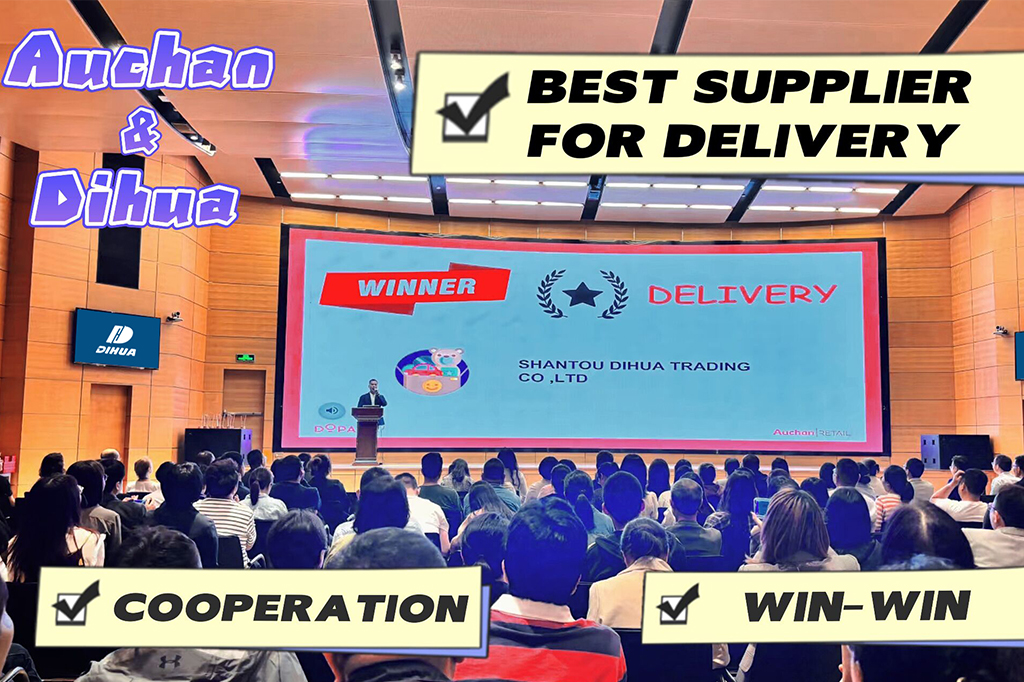
Leveraging resources from the Shantou toy manufacturing cluster, Dihua supports toy buyers throughout the process, from candidate SKU selection and testing documentation review to sourcing coordination and order execution, helping transform product planning into practical market implementation.
With access to a 6,000㎡ showroom and more than 1,000,000 continuously updated SKUs, Dihua helps buyers identify city service vehicle products based on target markets, sales channels, age groups, and price tiers.
By staying connected with factory-side innovations, including new mechanical structures and cost-efficient light-and-sound solutions, Dihua helps buyers discover potential product opportunities earlier, evaluate whether they can complement existing assortment gaps, and shorten the journey from product discovery and selection to market introduction.
Dihua does not simply provide a large product catalog. Instead, Dihua evaluates candidate SKUs based on different factory capabilities, production conditions, and cost advantages to identify product combinations with clearer functional differentiation, lower overlap, and more structured price tiers.
This helps reduce budget allocation toward highly similar products while enabling buyers to translate assortment strategies into more practical sourcing plans.
After SKUs are selected, Dihua’s certification team and in-house laboratory capabilities help review existing testing documentation and identify items requiring further confirmation based on target markets, age groups, models, materials, and functional configurations.
For projects requiring further coordination with third-party testing organizations, Dihua can leverage long-term partnerships with organizations such as BV, TÜV, SGS, and ITS to support testing coordination and documentation review.
This helps buyers improve communication efficiency and better prepare for mass production shipment and target-market customs clearance requirements.
If you are planning a city service vehicle toy assortment, contact the Dihua team for sourcing support.
Buyers can provide their target market, sales channels, age groups, price tiers, and expected order volumes.
Dihua can assist with city service vehicle SKU selection, functional configuration review, sourcing condition evaluation, and existing testing documentation confirmation to support a more structured and controllable sourcing process.
 Hot News
Dihua specializes in sourcing,productdevelopment,production tracking,sales,and service.
Headquarters:
No.1 Leshan Road, Longhu District, Shantou, Guangdong, China
Hong Kong office:
Unit 2401,24/F, Million Fortune Industrial Centre, No.34-36 ChaiWan Kok Street, Tsuen Wan, NT, Hong Kong
Copyright © Shantou Dihua Trading Co.,Ltd. All Rights Reserved Privacy Policy

 EN
EN
 FR
FR
 JA
JA
 RU
RU
 ES
ES