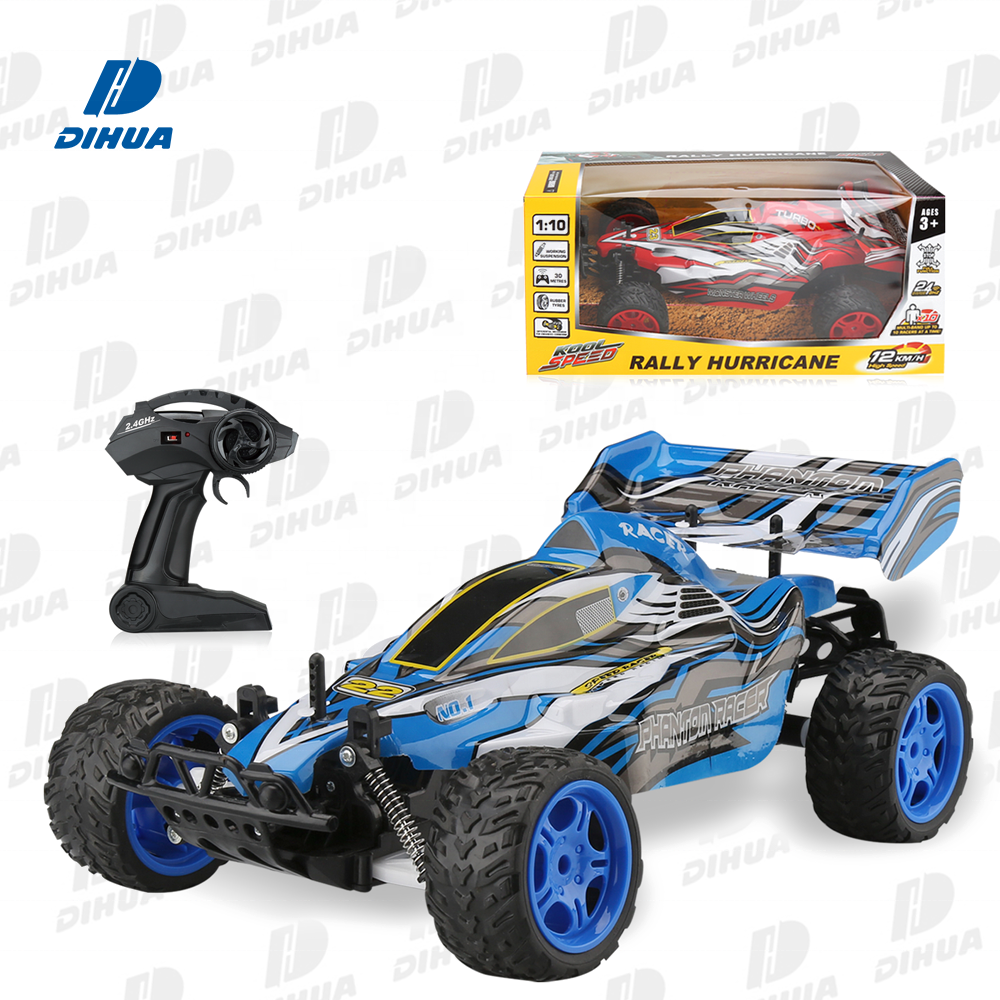
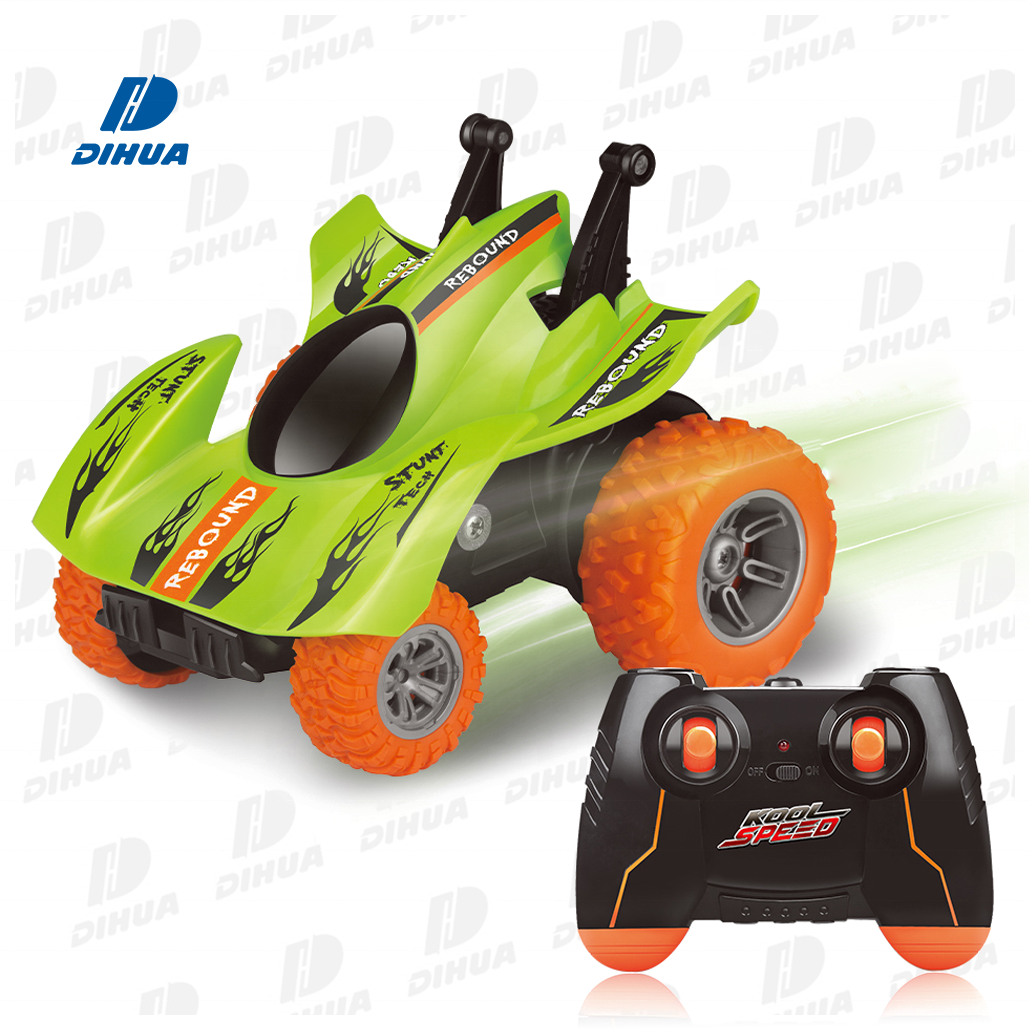
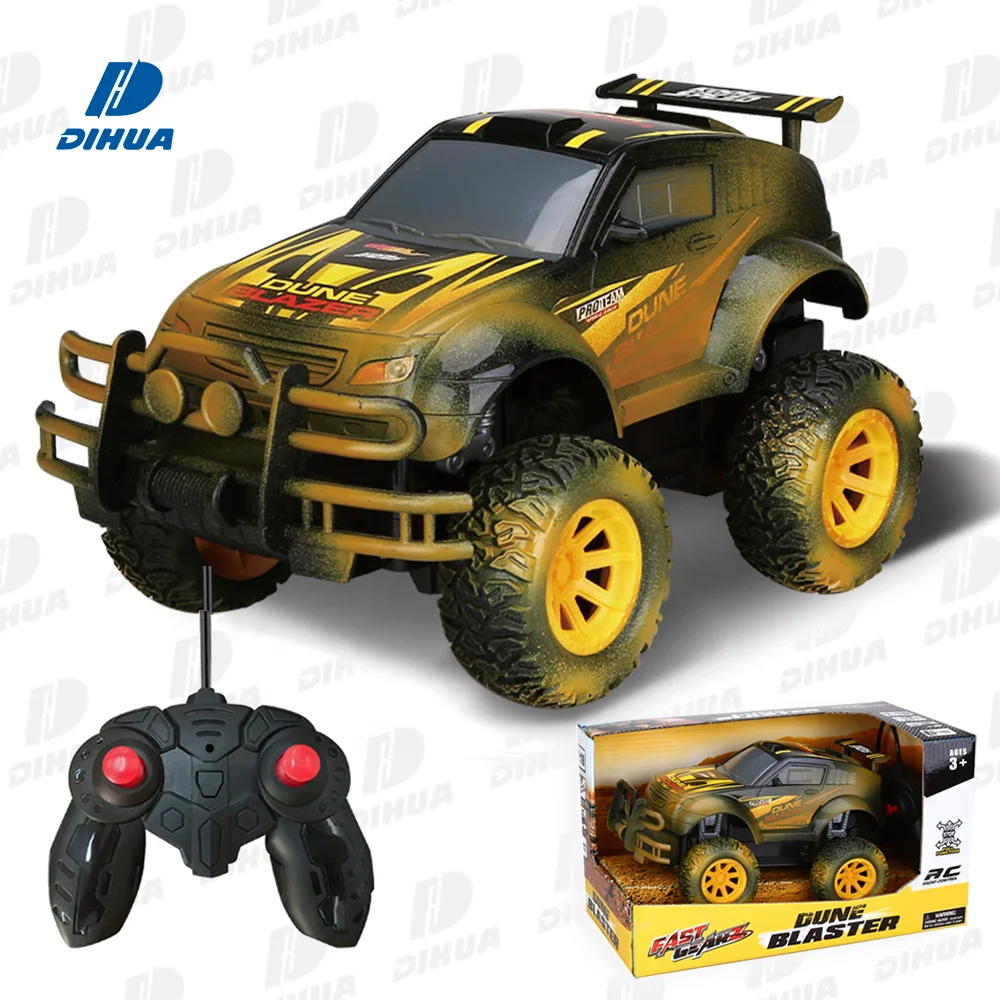
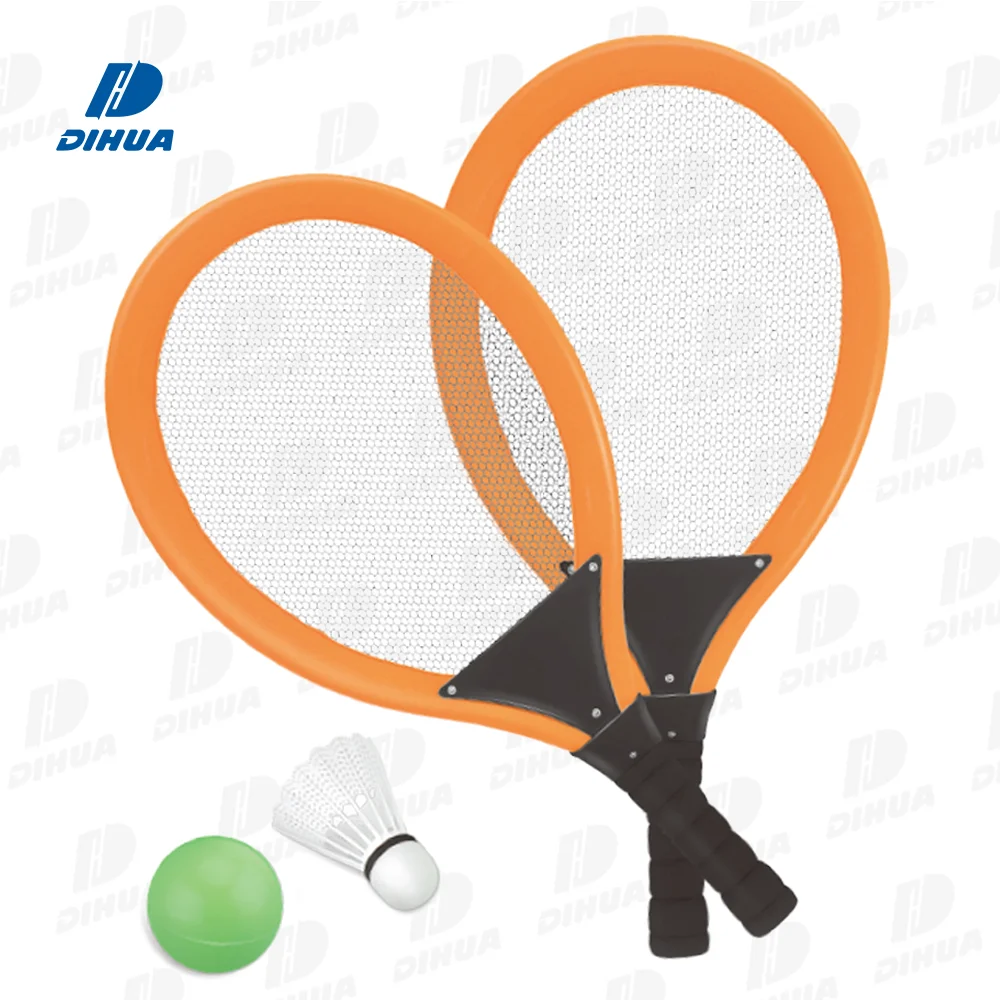
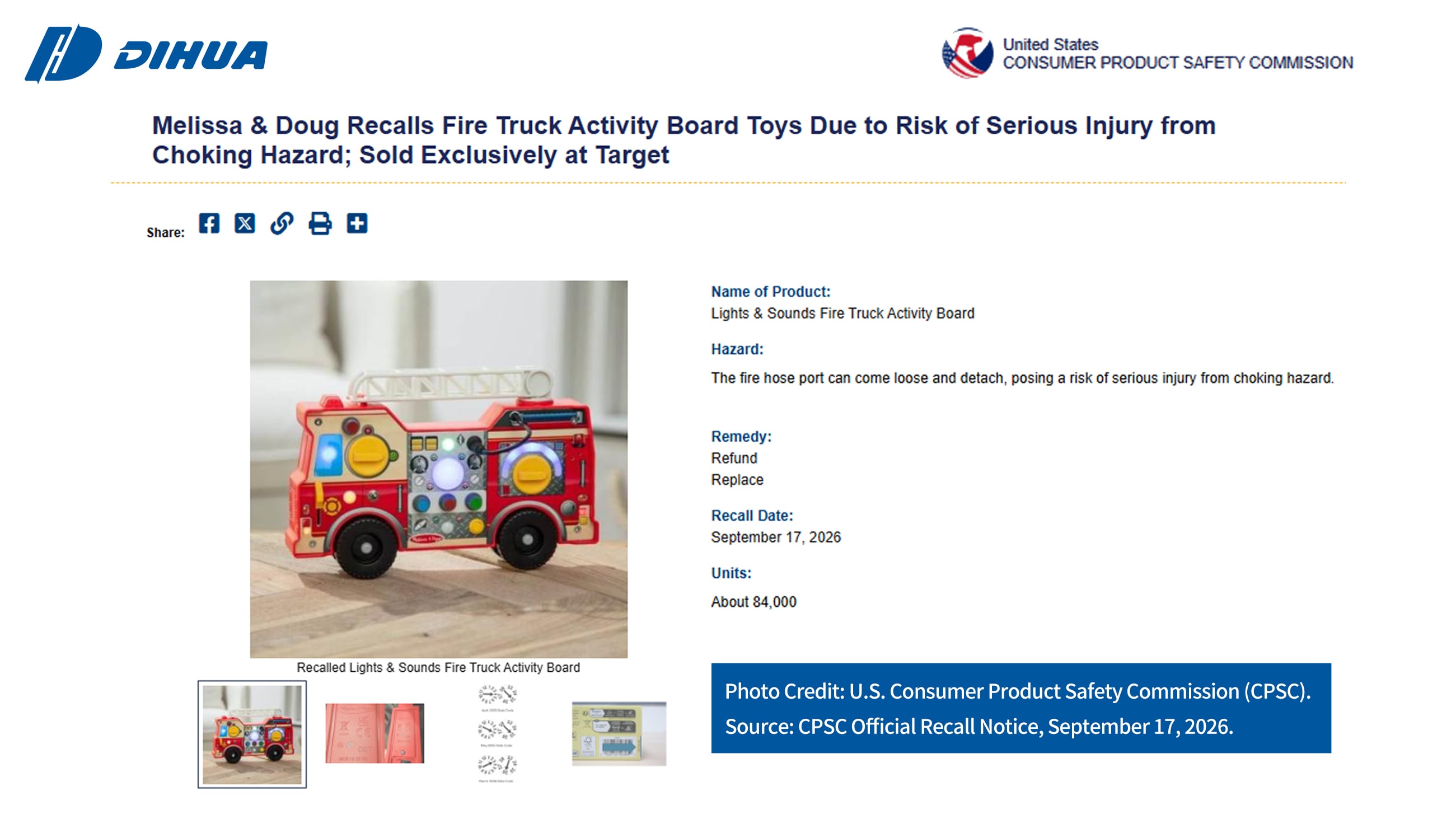
This recall highlights why toy sourcing safety reviews should go beyond test reports and material compliance. For products with detachable components, buyers should also pay close attention to connection methods, structural durability, and applicable use and abuse testing. In addition, buyers need to verify that mass-produced products remain consistent with the approved sample and that suppliers maintain adequate quality records and batch traceability.
For toy importers and wholesalers sourcing products for the U.S. market, establishing a comprehensive review process covering supplier selection, product verification, and mass production management is essential to reducing sourcing risks.
Preschool toys are primarily designed for children aged 3 to 5. Testing requirements vary by product category due to differences in materials, structures, and functions. For example, building blocks require attention to small parts and magnets; plush toys require checks on filling materials and structural safety; and electronic and RC toys require additional consideration of batteries, sound levels, and moving components.
However, children's toys entering the U.S. market share several fundamental compliance requirements. For purchasing teams, three fundamental aspects of U.S. toy safety compliance are particularly important.
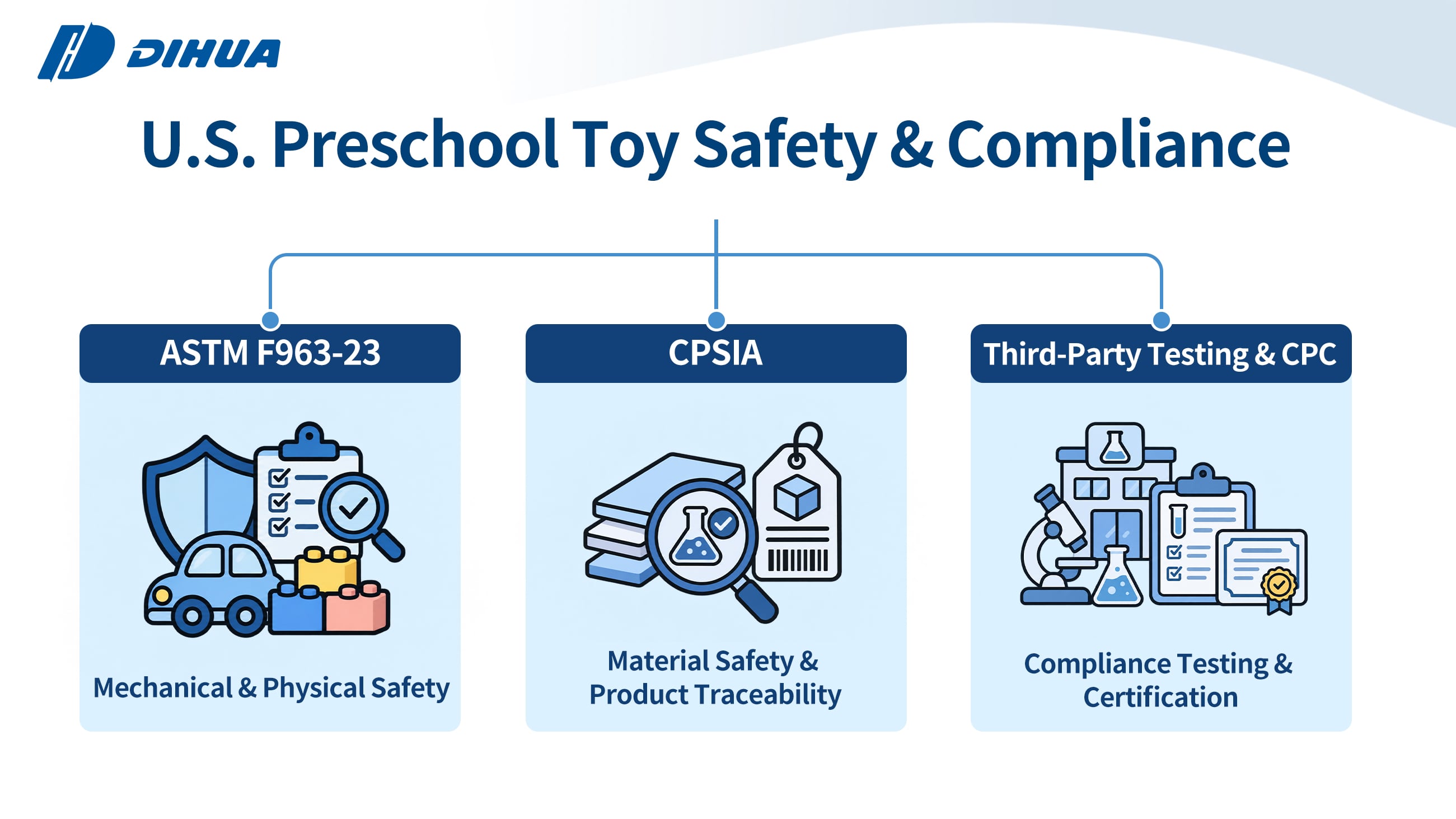
ASTM F963-23 is the mandatory U.S. toy safety standard, incorporated into federal regulation 16 CFR Part 1250. It covers mechanical, physical, and other applicable safety requirements for toys.
Specific testing requirements depend on the toy type and age grading. Common requirements include assessments of small parts, sharp edges, moving components, and structural integrity. For toys with detachable accessories, applicable Use and Abuse Testing is also required. Pull, torque, and impact tests help assess whether components may loosen, detach, break, or create additional safety hazards after normal use and reasonably foreseeable abuse.
In addition, the small parts ban applies to toys intended for children under 3 years of age. Applicable toys intended for children aged 3 to under 6 that contain small parts as defined by the regulations must carry the required choking hazard warning.
The Consumer Product Safety Improvement Act (CPSIA) establishes requirements for hazardous substance content in children's products and product traceability labeling. Buyers need to confirm applicable testing and labeling requirements based on product materials and accessible components.
· Total Lead Content: Applicable accessible components must not exceed 100 ppm.
· Lead in Paint: Paint and similar surface coatings must not exceed 90 ppm.
· Phthalates: Each of the eight restricted phthalates must not exceed 0.1% in applicable accessible components.
· Tracking Label Business Guidance: Products and packaging must carry permanent tracking information to the extent practicable, including the manufacturer, importer or private labeler, production location, date, and batch information.
For example, when sourcing plastic toys, buyers need to confirm applicable total lead testing for relevant components. If a product contains soft PVC or other plasticized materials, applicable phthalate testing also needs to be reviewed.
Toys intended for children aged 12 and under must undergo third-party testing and certification in accordance with applicable children's product safety rules. Testing must be conducted by a CPSC-accepted laboratory whose accreditation scope covers the relevant testing requirements.
For children's toys manufactured overseas and imported into the United States, the U.S. importer is generally responsible for issuing the Children's Product Certificate (CPC) based on qualifying test results. The testing laboratory issues the test report, not the CPC.
When sourcing preschool toys, importers and wholesalers need to look beyond whether a supplier can provide test reports.
To reduce risks associated with importation, retail market entry, and subsequent sales, buyers can focus on the following five key sourcing checkpoints.
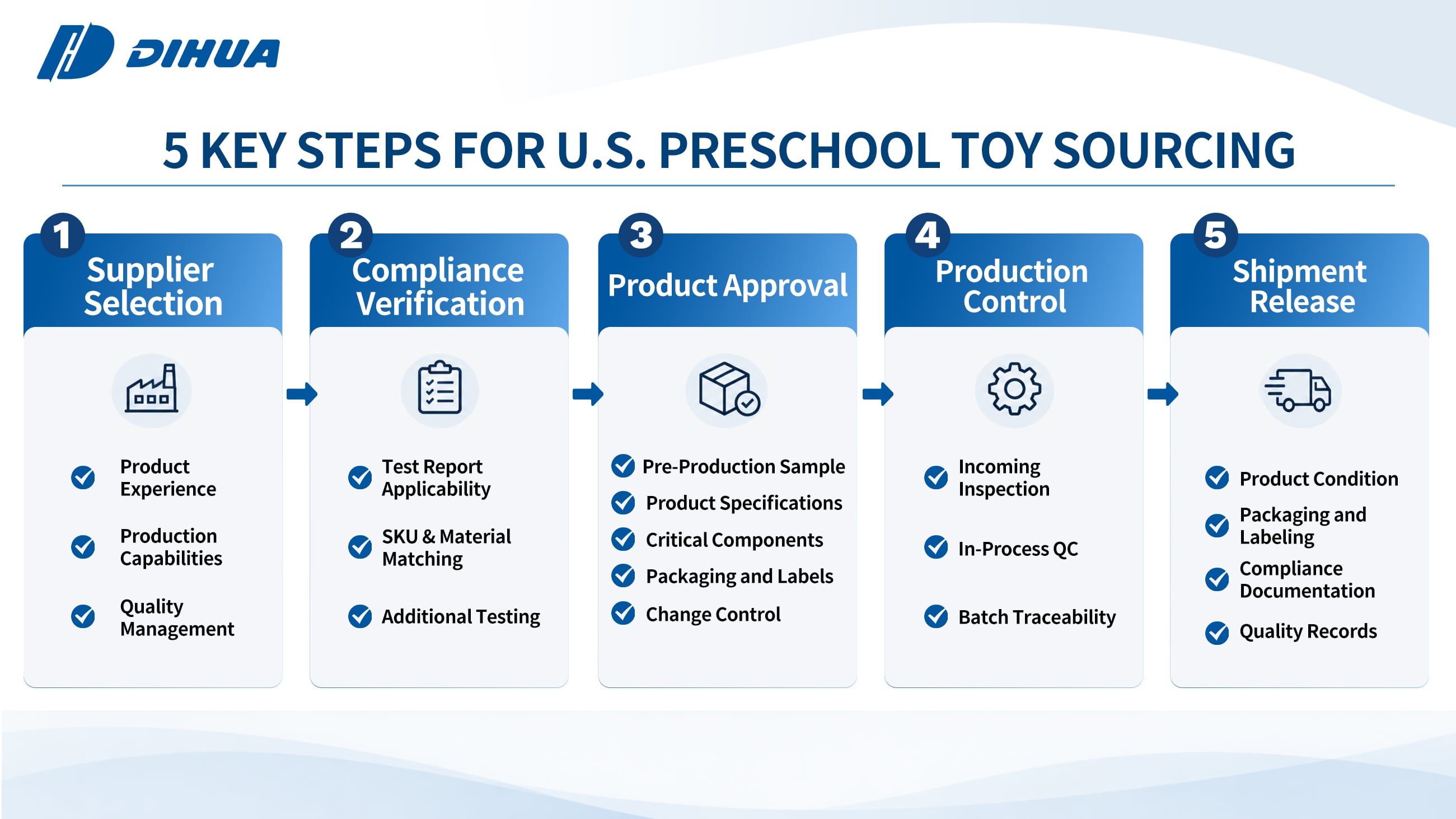
Selecting a reliable supplier is the first step in reducing sourcing risks. In addition to comparing product ranges, quotations, and Minimum Order Quantities (MOQs), buyers need to assess whether suppliers have relevant preschool toy development and manufacturing experience and understand U.S. market requirement.
Key areas to verify include:
· Product Experience: Whether the supplier has experience developing and manufacturing toys for different age groups, particularly children aged 3 to 5, and understands the safety requirements applicable to different age grades, including small parts restrictions, choking hazard warnings, detachable components, magnets, and battery compartments.
· Production Capabilities: Whether the supplier can provide information about its actual manufacturing facilities, key production processes, assembly procedures, and outsourced operations.
· Quality Management: Whether the supplier has established incoming material inspection, in-process quality control, and finished product inspection procedures, and can verify the attachment strength and structural integrity of critical components such as clips, knobs, and connectors.
A supplier's test reports do not automatically apply to every product within the same series. Differences in model numbers, age grading, materials, colors, or critical structural components may affect the scope and applicability of a test report.
Verification requirements vary depending on the sourcing project:
· New Product Development: Identify the applicable U.S. safety standards and testing requirements based on the product's intended age group, materials, structure, and functions. Representative samples can then be submitted to a CPSC-accepted testing laboratory. For products containing button or coin batteries, applicable requirements under 16 CFR Part 1263 also need to be verified.
· Existing or Same-Model Product Sourcing: Request the supplier's existing test reports, Children's Product Certificate (CPC), and product specifications. Cross-check the model number, materials, and key configurations against the actual purchasing SKU. If discrepancies are identified, first determine whether the existing test reports cover the relevant changes. Additional testing can be arranged where necessary, rather than automatically accepting the existing reports or repeating the entire testing process.
| Verification Item | Key Points for Buyers to Confirm |
| Laboratory | Whether the laboratory is CPSC-accepted and its accreditation scope covers the relevant testing requirements |
| Product Information | Whether the model number, age grading, materials, and key configurations match the purchasing SKU |
| Testing Scope | Whether testing covers applicable requirements under ASTM F963, lead content limits, and phthalate restrictions |
| CPC | Whether the certificate is issued based on passing third-party test results and its information corresponds to the purchased product |
After product selection, quotation, and PI and PO confirmation, the supplier provides a pre-production sample for the buyer's review and written approval before mass production. The approved sample serves as the reference for subsequent production and quality inspections.
Without final approval of the sample and product specifications, unauthorized changes to materials, components, dimensions, or assembly methods during production may affect product safety and batch consistency.
Buyers should focus on the following points:
· Pre-Production Sample: Verify the product's appearance, structure, functions, and workmanship.
· Product Specifications: Confirm dimensions, materials, colors, functions, and applicable age grading.
· Critical Components: Check connectors, detachable accessories, magnets, and battery compartments.
· Packaging and Labeling: Verify age grading, safety warnings, and tracking label information.
· Change Control: Require the supplier to notify the buyer in advance and obtain written approval for any changes affecting approved specifications.
The final approved sample and product specifications should be linked to the corresponding PO and order records. Any subsequent changes that may affect product compliance need to be assessed before implementation, with additional testing or CPC updates determined according to the nature of the changes.
For retailers and wholesalers, sourcing risks extend beyond the quality of the initial production run.
Maintaining consistent materials, product structures, and quality standards throughout subsequent production runs is equally important.
During mass production, buyers should pay particular attention to the following quality control checkpoints:
| Key Control Area | Factory Inspection Stage and Control Measures |
| Raw Materials and Components | IQC (Incoming Quality Control): Verify the specifications, suppliers, and batch details of plastics, coatings, connectors, and other critical components. |
| Assembly Quality | IPQC (In-Process Quality Control): Check fasteners, screws, magnet fixation, battery compartments, and structural connections. |
| Finished Product Consistency | FQC/OQC (Final Quality Control / Outgoing Quality Control): Verify product functions, structure, labeling, packaging, and consistency with approved samples. |
| Production Changes | Change Control: Document changes to materials, component sources, product designs, and manufacturing processes, and conduct additional compliance reviews where necessary. |
Production records should also be retained, including key material details, production batch records, and inspection reports, to support quality verification and subsequent traceability.
For children's products under ongoing production, periodic testing or production testing plans should also be established in accordance with applicable requirements. This does not mean that full third-party testing must be repeated for every reorder or production batch. Testing frequency depends on the applicable testing program, production conditions, and risk assessment. If significant changes may affect product compliance, the testing requirements for the affected components or finished products need to be reassessed.
Before shipment, buyers need to ensure that the supplier has completed final inspections and that the products ready for delivery conform to the approved samples, purchasing specifications, and applicable compliance documentation.
· Finished Products: Verify that finished products match the final specifications and approved samples, with no unauthorized changes to critical structures.
· Packaging and Labeling: Check the accuracy of age grading, choking hazard warnings , tracking labels, and other packaging information.
· Compliance Documentation: Ensure that test reports correspond to the final purchasing SKUs, and that the CPC is issued by the responsible U.S. importer based on passing test results. Also verify that the required data for import declarations and applicable CPSC eFiling submissions is complete.
· Quality Records: Confirm that production inspection reports, batch records, and pre-shipment inspection records are complete, and that identified quality issues have been addressed.
Once these items have been verified, the order can proceed to final shipment release. However, shipment does not mark the end of compliance management. Significant changes to materials, product structures, or critical component sources still require an assessment of whether additional testing or a CPC update is necessary.
By following these five stages, buyers can establish a comprehensive purchasing quality control process covering supplier selection, product verification, mass production, and shipment. This helps reduce import and sales risks arising from product specification changes, batch inconsistencies, or mismatched compliance documentation.
For preschool toy sourcing projects targeting the U.S. Market, product design, testing requirements, and production consistency need to be managed throughout the development and manufacturing process. With 26 years of experience in toy exports, Dihua supports buyers through three key areas: product development, compliance testing coordination, and production quality control.
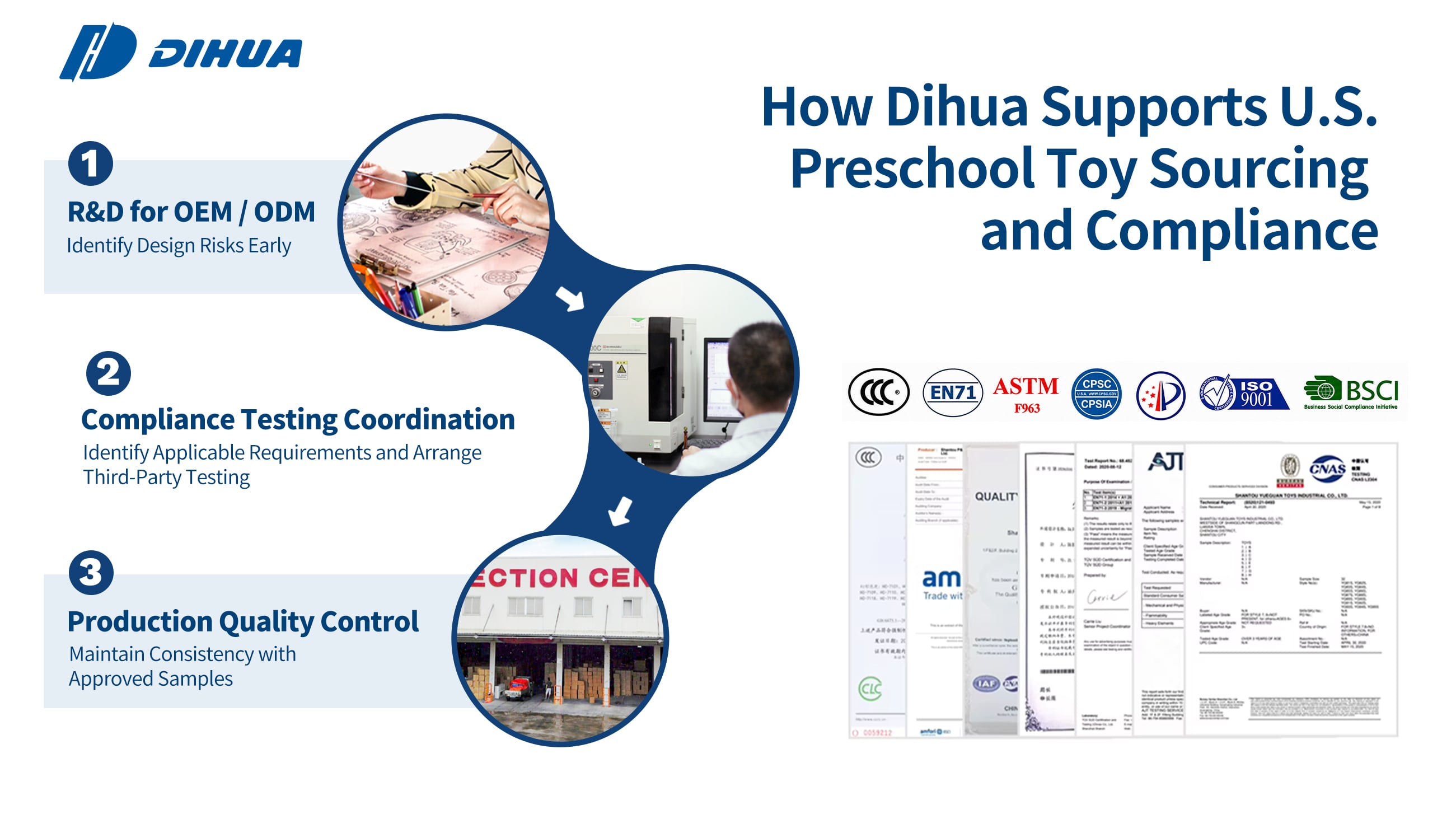
For OEM/ODM projects or products requiring structural modifications, Dihua's 20-member product development team and 10-member design team provide 3D modeling, prototype development, and structural validation. These processes help verify product dimensions, connection methods, and critical component designs before mass production. For preschool toys featuring snap-fit parts, knobs, connectors, and similar structures, potential assembly risks can be identified and addressed at an early stage.
Based on the target market, age grading, materials, and product functions, Dihua assists buyers in identifying applicable ASTM F963 testing requirements and CPSIA-related testing for lead content, phthalates, and other restricted substances.
Dihua's in-house laboratory supports pre-production screening, in-process inspections, and pre-shipment quality verification. Dihua also works with third-party testing organizations, including ITS, SGS, BV, and TÜV, to coordinate testing according to project requirements.
For products requiring mandatory third-party testing, Dihua coordinates with laboratories holding the relevant CPSC-accepted accreditation and testing scope, helping ensure that testing documentation corresponds to the actual purchasing SKUs.
During mass production, Dihua's QC team implements IQC, IPQC, FQC, and OQC procedures covering incoming materials, production processes, finished products, and pre-shipment inspections. Key control points include material specifications, connecting components, assembly integrity, and product configurations.
Production inspections and change control procedures also help track changes to materials, components, and manufacturing processes, reducing the risk of unauthorized modifications affecting product quality and compliance.
By coordinating product development, third-party testing, and mass production quality control, Dihua helps buyers reduce product development risks, minimize compliance coordination efforts, and maintain quality consistency across initial production orders and subsequent reorders.
If you are planning to source preschool toys for the U.S. market, share your product requirements and purchasing plans with Dihua. Based on product specifications and applicable U.S. market requirements, Dihua team can help assess the appropriate product development, testing, and quality control processes, and support subsequent sourcing and order fulfillment.
Q1: Which product structures require particular attention when sourcing preschool toys?
For toys intended for children aged 3–5, buyers should pay particular attention to detachable components, small parts, connection points, and moving parts. Under U.S. regulations, toys intended for children under 3 years of age are subject to the small parts prohibition. For applicable toys intended for children aged 3 to under 6 that contain small parts, choking hazard warnings are required.
Q2: Can Dihua support OEM/ODM development and compliance-focused sourcing of preschool toys for the U.S. market?
Yes. Dihua provides both existing product sourcing and OEM/ODM development services, including 3D modeling, prototype development, and structural modifications. Dihua also coordinates applicable testing through its in-house laboratory and third-party testing organizations such as ITS, SGS, BV, and TÜV. During mass production, IQC, IPQC, FQC, and OQC procedures help maintain product quality. The CPC is issued by the responsible U.S. importer based on applicable test results.
Q3: What additional compliance requirements apply to RC toy cars exported to the U.S. market?
In addition to applicable toy safety regulations and standards, such as ASTM F963 and CPSIA, buyers need to consider the battery type, wireless communication technology, and product design. Key requirements include:
Battery and Mechanical Safety: Check battery compartment security, wheels, and moving components, and assess potential risks involving detachable parts and battery access.
· FCC Radio Frequency Requirements: For products using 2.4GHz, 27MHz, or other wireless remote control technologies, verify applicable FCC Part 15 requirements and equipment authorization procedures based on the transmitter design and operating frequency.
· Lithium Battery Transportation Requirements: For products equipped with rechargeable lithium batteries, verify compliance with UN 38.3 transport testing requirements and ensure that the required test summary and supporting transportation documentation are available.
It is important to note that toy safety, radio frequency compliance, and battery transportation requirements fall under different regulatory frameworks and cannot substitute for one another. Applicable requirements need to be assessed individually based on the product configuration, sales market, and transportation method.
 Hot News

Dihua specializes in sourcing,productdevelopment,production tracking,sales,and service.
Headquarters:
No.1 Leshan Road, Longhu District, Shantou, Guangdong, China
Hong Kong office:
Unit 2401,24/F, Million Fortune Industrial Centre, No.34-36 ChaiWan Kok Street, Tsuen Wan, NT, Hong Kong
Copyright © Shantou Dihua Trading Co.,Ltd. All Rights Reserved Privacy Policy

 EN
 FR
 JA
 RU
 ES