Peak season is a test of a supplier’s order fulfillment and delivery management. Stockouts during this period are not the result of stronger-than-expected sales; they also reveal insufficient delivery capacity to support stable order fulfillment during high-demand periods.
This issue is especially common in toy programs because many orders are planned around fixed launch dates, seasonal promotions, replenishment cycles, and market delivery windows, while order volumes, replenishment needs, and shipping pressure become more concentrated during peak season. If production planning, compliance management, inventory coordination, or shipping schedules are not aligned early, even strong-selling products may miss their intended market window.
This article outlines the key capabilities that support a toy supplier’s reliability in order fulfillment and delivery management, helping buyers better evaluate a supplier’s delivery capability. It also explains how Dihua, as a reliable toy supply chain partner, supports more predictable delivery across different markets.

When building a long-term partnership, toy buyers need to evaluate not only what a supplier offers, but also how reliably it can execute. For global retailers, importers, and brand owners, a supplier’s reliability in order fulfillment and delivery management depends on several connected capabilities: compliance management, seasonal planning, supply chain coordination , and export fulfillment.
By evaluating these capabilities, toy buyers can better understand whether a supplier is able to support consistent order fulfillment from production planning to final delivery.
A toy shipment can be production-ready but still fail to move forward on schedule if compliance readiness is not in place, which is why compliance management should be treated as part of shipment readiness, not just product approval.
Compliance management covers product testing, safety standards, labeling requirements, battery handling, packaging information, export documentation preparation, and coordination of documents required by the buyer for customs clearance in the destination market.
For buyers selling into the EU, the United States, and other regulated markets, missing test reports, incorrect warning labels, or inaccurate export documents may lead to inspections, shipment delays, relabeling requests, or additional clearance costs.
A reliable toy supplier takes a more structured approach, with compliance processes, documentation control, and pre-shipment checks in place to help buyers reduce avoidable delivery risks and keep cross-border distribution moving more smoothly.
Peak season does not simply test a supplier’s production scale; more importantly, it tests how responsive the supplier can be in delivery execution when demand fluctuates. For toy buyers, stable supply is not determined by one-time production capacity alone, but by whether the supplier can plan ahead and respond quickly to market changes.
Seasonal agility is reflected in whether a supplier can prepare for high-demand periods in advance, including production scheduling, inventory readiness, warehouse resource allocation, and shipment planning. It also depends on whether the supplier can adjust delivery plans quickly when orders increase unexpectedly, replenishment needs become concentrated, or promotional timelines shift, helping maintain supply continuity.
Seasonal agility is especially important in Q4, holiday sales seasons, and key promotional windows. As market demand becomes more concentrated and replenishment cycles shorten, insufficient coordination at any stage may lead to delayed delivery or even stockout risks.
Therefore, a reliable toy supplier typically needs forward seasonal planning, flexible production coordination, and scalable warehousing and delivery support to help buyers maintain more consistent order fulfillment during peak season and reduce potential sales losses caused by supply fluctuations.

In toy sourcing, stable order delivery does not depend only on whether a single product can be completed on time. It also depends on whether multiple products, production stages, and delivery milestones can move forward in sync. For projects involving multiple SKUs, different packaging formats, and several delivery schedules, a delay in any one stage may affect the shipment timeline of the entire order.
Delivery coordination reflects whether a supplier has a clear order progress management system. This includes coordinating production schedules, packaging readiness, inventory flow, and shipment planning, while adjusting stock preparation and replenishment timing based on the buyer’s sales forecast to keep overall delivery more stable.
A reliable toy supplier typically needs stable resource integration capability, flexible inventory management, and continuous order execution tracking to help reduce the risk of overstock or stockouts, improve replenishment efficiency, and support more consistent order fulfillment across different markets.
Without effective shipment coordination, any issue in booking arrangements, export documentation, customs declaration, or shipment scheduling may cause a completed order to be delivered late.
Export fulfillment reflects whether a supplier can manage key shipping milestones consistently. This includes booking arrangements, ETD control, export document preparation, customs declaration coordination, trucking arrangements, cargo delivery to port, and delivery progress tracking. For international toy programs, whether goods can leave the port on schedule often depends on how well these steps are coordinated.
A reliable toy supplier typically needs a systematic shipment process, accurate documentation management, and clear, efficient communication with freight forwarders and carriers. It should also be able to adjust shipment plans based on the destination market, order urgency, and shipment volume, helping support more stable order fulfillment.
Taken together, these capabilities give buyers a practical way to evaluate whether a toy supplier can support reliable order fulfillment and delivery management beyond production alone. A supplier with strong compliance management, seasonal agility, supply chain coordination , and export fulfillment is better positioned to reduce avoidable delays, improve delivery visibility, and support more stable order fulfillment across different markets.

Reliable order fulfillment and delivery management do not start at the shipping stage and they start much earlier, when market demand is reviewed, product requirements are aligned, suppliers are matched, compliance is planned, production is tracked, and shipment documents are prepared.
This is where Dihua’s one-stop service workflow becomes relevant. Since 2001, Dihua has supported global retailers, importers, distributors, and brand owners as a China-based OEM/ODM and sourcing partner. Instead of working as a single-step supplier, Dihua connects sourcing, product development, production tracking, compliance coordination, quality control, warehousing, and export service into a coordinated one-stop workflow.
At Dihua, compliance is not treated as a last-minute check before shipment.
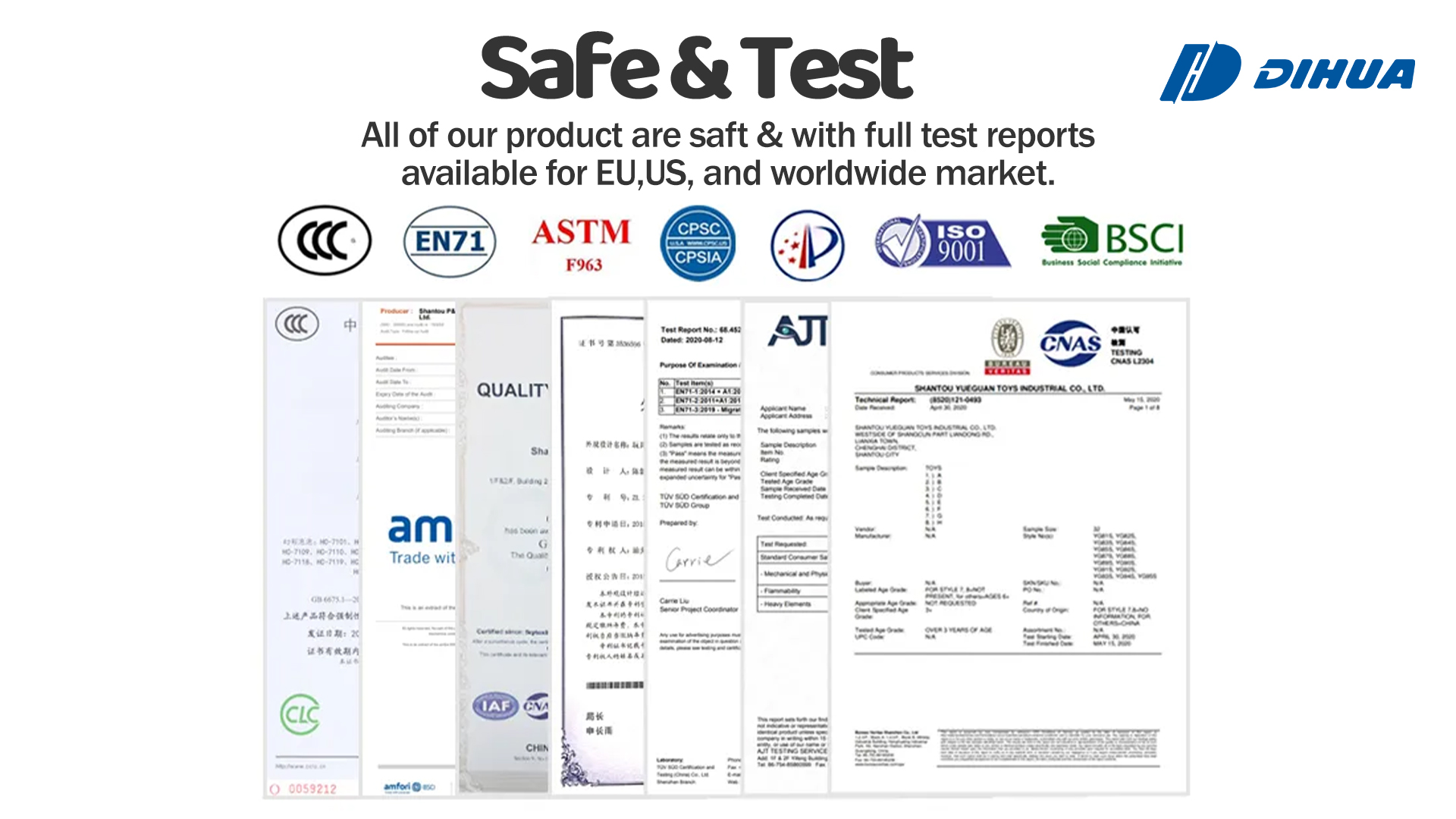
Dihua supports key testing and compliance requirements such as EN71, EN62115, EMC, RED, and PAHs. With its in-house laboratory, QC team, and long-standing cooperation with recognized testing partners such as BV, TÜV, SGS, and ITS, Dihua has built a smoother testing communication and priority response mechanism.
With more timely access to regulatory and testing standard updates, and high efficiency of test scheduling, report issuance, and compliance documentation coordination, Dihua helps buyers shorten compliance preparation cycles, reduce repeated communication costs, and lower order execution risks caused by testing or documentation delays.
At Dihua, seasonal planning is not treated as a last-minute response to peak-season pressure. It is advanced through milestone-based execution. For high-demand periods, Dihua works backward from the required delivery window and manages key milestones such as sample confirmation, packaging approval, product testing, supplier capacity coordination, final inspection, and shipment. This helps critical steps be confirmed before production and shipping pressure becomes concentrated.
For priority SKUs or more complex programs, Dihua also combines capacity planning, material readiness, production batching, warehouse consolidation, and shipment arrangements to support multi-stage fulfillment and phased execution. This helps buyers improve visibility into peak-season planning and reduce delivery risks caused by poorly controlled execution milestones.
For many toy buyers, toy orders are rarely built around a single product. They often involve a mix of categories, price points, packaging formats, and delivery schedules. This is where Dihua’s multi-SKU coordination becomes important for assortment-based toy programs.
Dihua maintains more than 1,000,000 active and regularly updated product records in its system, supported by a well-organized showroom with daily sample updates. This gives buyers broader product visibility during selection and helps Dihua respond more efficiently when building category promotions, seasonal collections, or buyer-specific assortments.
Rather than relying on a single fixed shipping arrangement, Dihua can adjust shipping plans according to the destination market, order urgency, shipment volume, and buyer requirements. By combining freight forwarder coordination, export documentation control, warehouse consolidation, and flexible shipping execution, Dihua helps global toy buyers improve delivery visibility, reduce international transit uncertainty, and support more predictable order fulfillment across different markets.

Peak-season stockouts are not only a sales-side issue. For toy buyers, they often reflect challenges in supply chain execution, and these risks can usually be managed earlier through forward planning, compliance readiness, multi-SKU coordination, and export execution management.
For buyers preparing seasonal programs or complex multi-SKU toy orders, a truly reliable partner is not only able to complete production. More importantly, it should be able to integrate supply chain resources, coordinate delivery timelines, and support stable order fulfillment.
Through its one-stop service workflow, Dihua helps buyers reduce avoidable delivery risks, improve supply chain visibility, and achieve more efficient and predictable order fulfillment across different market. Toy buyers attending the Spring Canton Fair are warmly invited to visit Dihua at Booth 17.1B34-35 C10-11. Dihua team will be available on site to discuss sourcing requirements, explore product development opportunities, and share how Dihua’s one-stop supply chain workflow supports more predictable delivery for partners across different markets. Learn more at Dihua official website:www.dihuatoys.com.
 Hot News
Dihua specializes in sourcing,productdevelopment,production tracking,sales,and service.
Headquarters:
No.1 Leshan Road, Longhu District, Shantou, Guangdong, China
Hong Kong office:
Unit 2401,24/F, Million Fortune Industrial Centre, No.34-36 ChaiWan Kok Street, Tsuen Wan, NT, Hong Kong
Copyright © Shantou Dihua Trading Co.,Ltd. All Rights Reserved Privacy Policy

 EN
EN
 FR
FR
 JA
JA
 RU
RU
 ES
ES