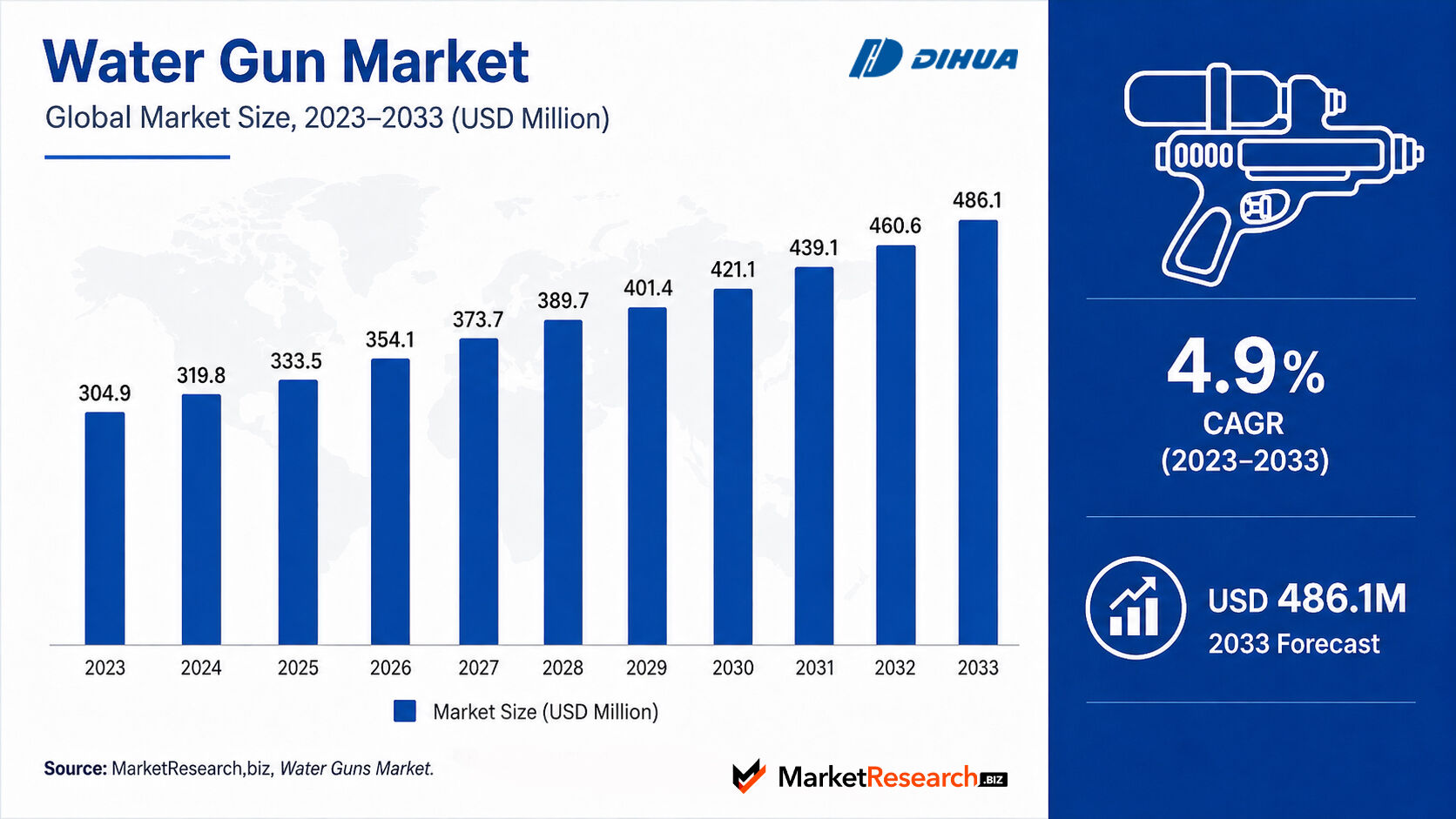
According to MarketResearch.biz, the global water guns market was valued at USD 304.9 million in 2023 and is expected to reach USD 486.1 million by 2033, with a CAGR of 4.9%. As summer toy demand continues to grow, more retailers, brand buyers, importers, and distributors are including water guns as an important seasonal toy category.
However, for toy buyers, a successful water gun sourcing project does not depend only on product design or purchase price. In real sourcing projects, many problems do not come from the product itself, but from insufficient supplier capability assessment, unclear quality control standards, delayed packaging preparation, weak replenishment planning, or poor delivery coordination.
For seasonal water gun programs with clear sales windows, these issues can quickly affect production schedules, shipment planning, and the buyer’s overall sales timeline. Therefore, before confirming a water gun supplier and sourcing plan, buyers need to identify key risks in advance and avoid the following five common sourcing mistakes.
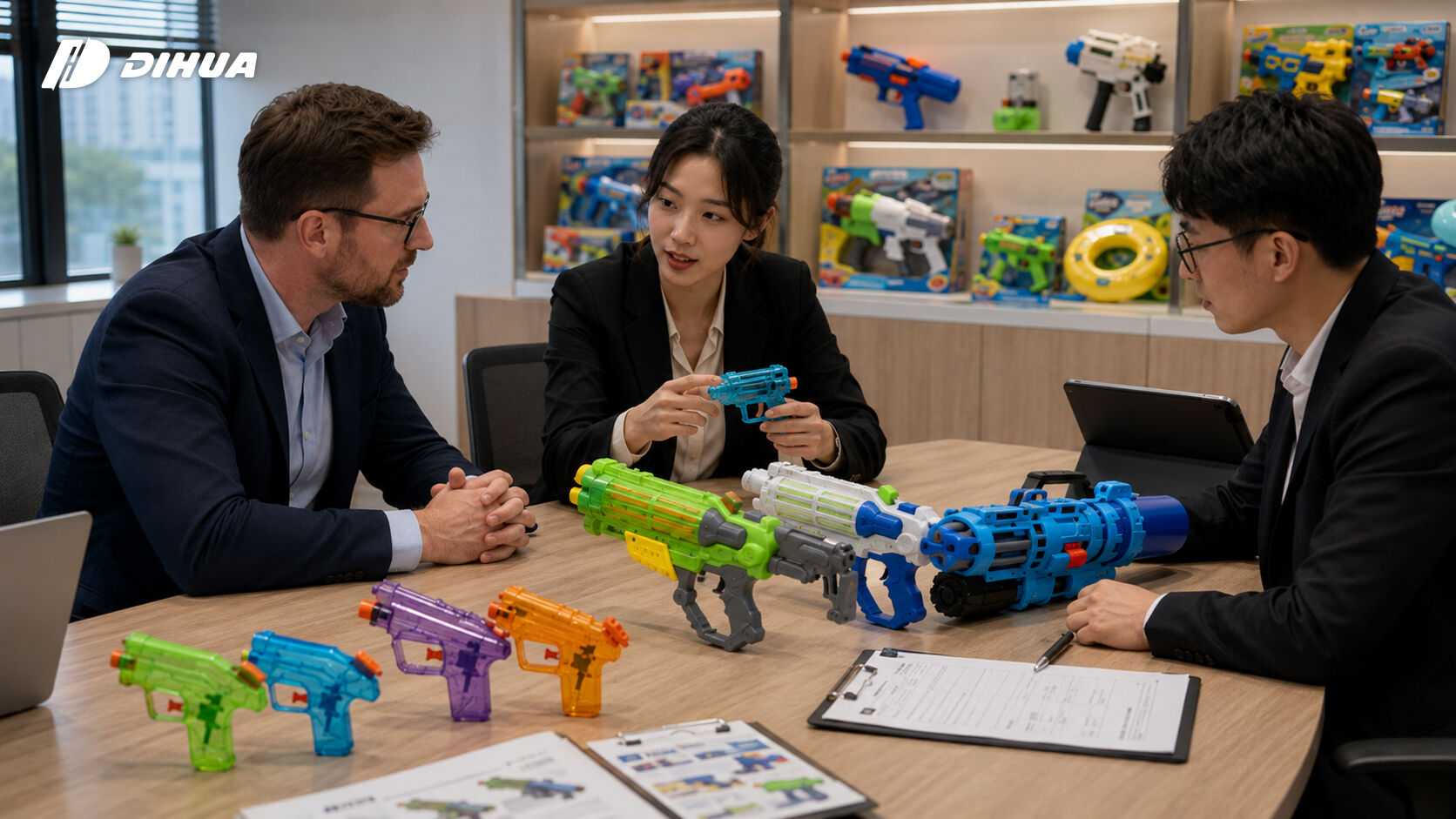
A common mistake in water gun sourcing is assuming that any supplier who can provide a good sample, a competitive quote, or a quick response can handle peak-season orders. These signals are useful at the early sourcing stage, but they do not prove that the supplier has enough production capacity, material preparation, quality control, packaging coordination, or delivery planning to support seasonal bulk orders.
A factory may complete sample development smoothly but still face pressure when several customers place bulk orders before the same summer season. If capacity is not confirmed early, buyers may face production delays, rushed approvals, limited restock options, or missed delivery windows.
Water guns are part of seasonal toy sourcing, so timing is closely linked to summer sales plans, retail launch windows, and export delivery schedules. Before confirming an order, buyers should review the supplier’s production capacity, production lead time, material preparation, packaging schedule, testing coordination, replenishment planning, and production follow-up process.
For peak-season water gun orders, toy buyers should look beyond samples and quotations. It is also important to assess whether the supplier can manage seasonal order pressure, coordinate production schedules, and support delivery planning within the required retail launch window.
Another common mistake in water gun sourcing is selecting too many products with similar market positioning without building a clear differentiation strategy for the overall assortment. Even if different water guns vary in color, size, or shape, they may still overlap in product role if they compete in the same price range, play scenario, or retail channel. This can result in a repetitive assortment with limited differentiation.
Before confirming a water gun assortment, buyers should consider how each item fits into the overall seasonal program. For example, manual water guns may work well as entry-level promotion SKUs, while larger pump or backpack water gun models may support outdoor summer displays and higher shelf impact. Electric water guns may appeal to a different price tier, but they also require closer checks on battery requirements, safety details, product instructions, quality control, and packaging communication.
For water gun programs, toy buyers should look beyond individual water gun styles and review whether the available product range can support a differentiated assortment across age groups, price tiers, play scenarios, packaging formats, and retail channels.
Price is always important in toy sourcing, but it should not be the only decision factor. Water guns are children’s outdoor toys, so buyers also need to review material safety, leak-resistant structure, spray performance, product durability, packaging warnings, labeling, and compliance documentation.
When buyers focus only on the lowest quotation, quality issues may appear later in the project. These can include leakage, weak spray performance, unstable assembly, sharp edges, loose parts, poor sealing, or inconsistent materials. For retailers, importers, and distributors, these issues may lead to customer complaints, returns, or retail channel problems.
Compliance should also be reviewed early according to the target market. Water gun programs may involve toy safety requirements, packaging information, warning labels, testing documentation, and material-related checks. If these requirements are discussed too late, buyers may need to revise packaging, arrange additional testing, or delay shipment preparation.
For water gun programs, toy buyers should look beyond price comparison. They need to assess whether the supplier can support material checks, product testing, compliance communication, and quality control, so the project can be reviewed more clearly across cost, product performance, compliance requirements, and market readiness.
A common mistake in water gun packaging is treating packaging as a final artwork task instead of part of the toy sourcing plan. For toy buyers, packaging affects retail display, toy packaging requirements, shipping protection, carton planning, and retail channel fit, so it should be discussed early with the water gun supplier. Delayed packaging approval can lead to artwork changes, missing labels, packaging rework, carton adjustments, shipment delays, or weak shelf impact.
Before confirming production, buyers should decide the right packaging format based on product size, water capacity, price tier, sales channel, shelf display needs, and logistics requirements. Retail stores may require stronger visual presentation and clear toy labeling requirements, while e-commerce packaging may need better protection, compact carton planning, and clearer product information that helps reduce return risk.
For water gun packaging, toy buyers should not wait until the final design stage to start discussions. They need to confirm whether packaging format, labeling requirements, sample approval, and shipping protection can be reviewed early, so the product is better prepared for retail display, e-commerce sales, export delivery, and market entry.
In water gun sourcing, sample approval should not be treated as the final quality checkpoint. A sample can verify the expected design, function, and appearance, but it does not guarantee that the supplier can maintain the same quality level throughout mass production.
For European and U.S. markets, water guns usually need to meet toy safety requirements such as EN71 or ASTM F963. In addition to material safety, testing may also involve drop, impact, and structural safety requirements. A sample passing testing does not necessarily mean that mass production goods will consistently meet the same standards.
Before mass production starts, buyers should clearly define quality requirements such as approved materials, key functions, leakage testing standards, drop test requirements, color specifications, and packaging requirements. This helps reduce the gap between approved samples and final goods.
During production, small changes in materials, sealing, assembly, or trigger mechanisms may lead to leakage, cracking, functional failure, or other quality issues. Without in-process quality control, even if the sample performs well, mass production goods may still create customer complaints or return risks.
Therefore, when selecting a water gun supplier, toy buyers should not only focus on sample quality. They should also evaluate whether the supplier has a complete in-process inspection, final inspection, and quality management capability to help ensure that mass production products can consistently meet order requirements.
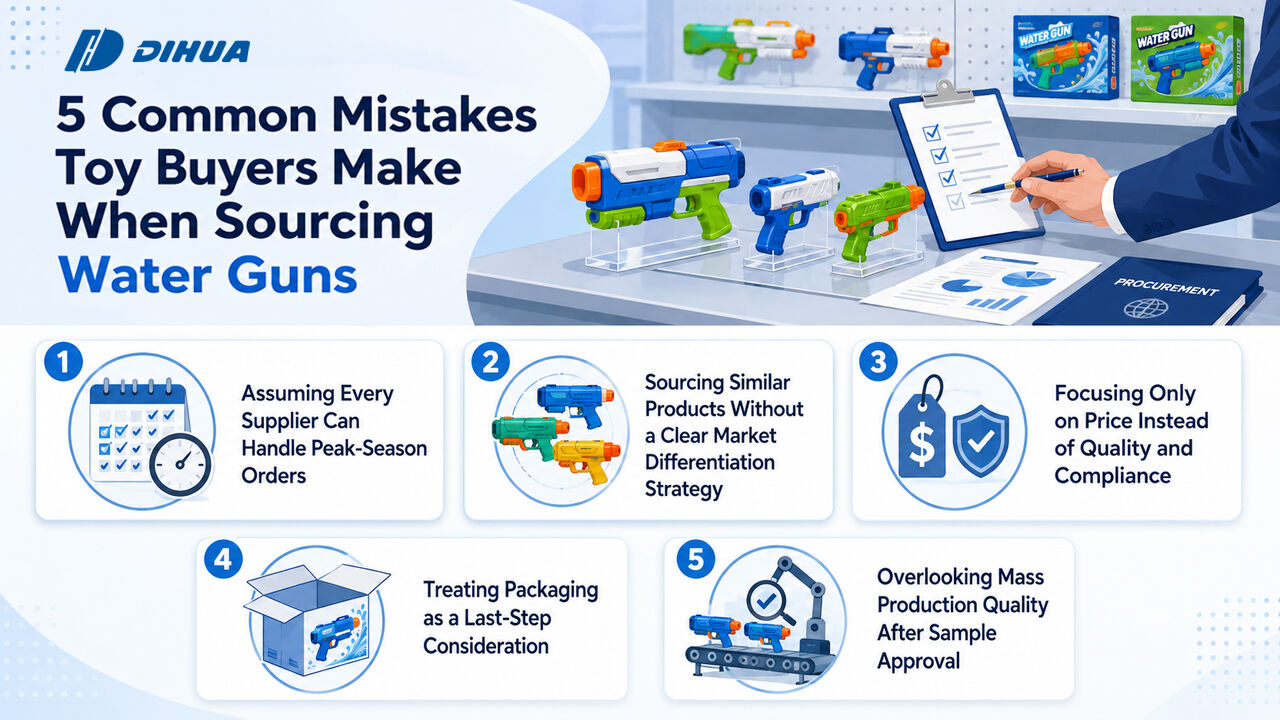
After reviewing these five common sourcing mistakes, one point becomes clear: a water gun project needs to be managed as a seasonal supply chain project, not just a product purchase.
This is where Dihua’s one-stop toy sourcing workflow can support the project more systematically. With more than 25 years of toy export experience, Dihua helps buyers coordinate water gun sourcing projects from product matching and requirement alignment to quality control, compliance communication, packaging coordination, production follow-up, and export delivery.
For peak-season water gun orders, early planning is essential. With 25+ years of toy export experience and 8,000+ orders processed per year, Dihua helps buyers align requirements, samples, production schedules, packaging approval, testing arrangements, and shipment windows earlier in the sourcing process.
This support helps reduce last-minute pressure before the summer sales window and makes seasonal water gun programs easier to manage.
Water gun buyers often need to compare different product types, functions, sizes, packaging formats, price tiers, and retail channel fit before confirming an assortment.
With 1,000,000+ active and updated SKUs and a 6,000㎡ toy showroom, Dihua helps buyers review product options more efficiently and build a more balanced seasonal assortment for different channels and price ranges.
For water guns, buyers need to review material safety, sealing performance, leakage risk, spray function, assembly stability, product durability, packaging warnings, and testing documents.
Dihua supports this part of the sourcing process through its Certification Team, In-House Lab, and QC Department. Dihua works with third-party testing organizations such as BV, TÜV, SGS, and ITS, and supports compliance communication for requirements such as EN71, ASTM F963, REACH, PAHs, and phthalate-related requirements. For products involving electronic, battery-powered, or wireless functions, requirements such as EN62115, EMC, RED, and FCC can also be further discussed.
This helps buyers review quality control and compliance support requirements earlier, especially when preparing water gun products for different target markets.
Packaging development can affect artwork approval, warning labels, color confirmation, carton planning, export packing, and retail display preparation.
Dihua’s Design Team supports packaging development, artwork coordination, and color approval, while the merchandising and QC teams help check whether packaging details stay aligned with the approved product and order requirements.
This helps reduce packaging rework and makes the final goods easier to prepare for retail display, delivery, and market entry.
After sample confirmation, buyers still need to manage production consistency. Small changes in material, color, sealing, trigger function, spray performance, assembly, or packaging can create a gap between the approved sample and the final goods.
Dihua’s 6,000+㎡ QC center supports buyers through production follow-up, in-process inspection, final quality checks, and pre-shipment inspection. This helps buyers monitor whether mass production remains aligned with the approved sample, quality requirements, packaging details, and shipment schedule.
For buyers looking for a reliable water gun supplier, Dihua provides support across product matching, seasonal order planning, quality control, compliance support, packaging coordination, mass production follow-up, and export delivery. This full-process support helps make water gun sourcing projects more controllable and better prepared for the right market, channel, and sales window.
If your team is preparing for a water gun sourcing project or summer toy program, Dihua can help coordinate product matching, packaging development, quality control, production follow-up, and export delivery within a more systematic sourcing workflow.
Contact Dihua to explore water gun sourcing support for your next seasonal toy program.
Yes. Dihua can help buyers review different water gun types, price tiers, packaging formats, and retail channel needs to build a more balanced summer toy assortment. This can include manual water guns, pump water guns, backpack water guns, electric water guns, and other seasonal water toy options.
Yes. Dihua can support OEM/ODM product projects from requirement alignment and product matching to packaging development, sample follow-up, production tracking, quality control, and export delivery. Buyers can discuss custom colors, packaging formats, product combinations, and target market requirements with the Dihua team.
Dihua supports water gun sourcing through its Certification Team, In-House Lab, QC Department, and cooperation with third-party testing organizations such as BV, TÜV, SGS, and ITS. From product development and sample confirmation to mass production and shipment, Dihua helps buyers identify potential risks earlier and confirm product testing, packaging warnings, labeling requirements, and target market compliance standards, helping reduce quality issues and improve project delivery stability.
 Hot News
Dihua specializes in sourcing,productdevelopment,production tracking,sales,and service.
Headquarters:
No.1 Leshan Road, Longhu District, Shantou, Guangdong, China
Hong Kong office:
Unit 2401,24/F, Million Fortune Industrial Centre, No.34-36 ChaiWan Kok Street, Tsuen Wan, NT, Hong Kong
Copyright © Shantou Dihua Trading Co.,Ltd. All Rights Reserved Privacy Policy

 EN
EN
 FR
FR
 JA
JA
 RU
RU
 ES
ES